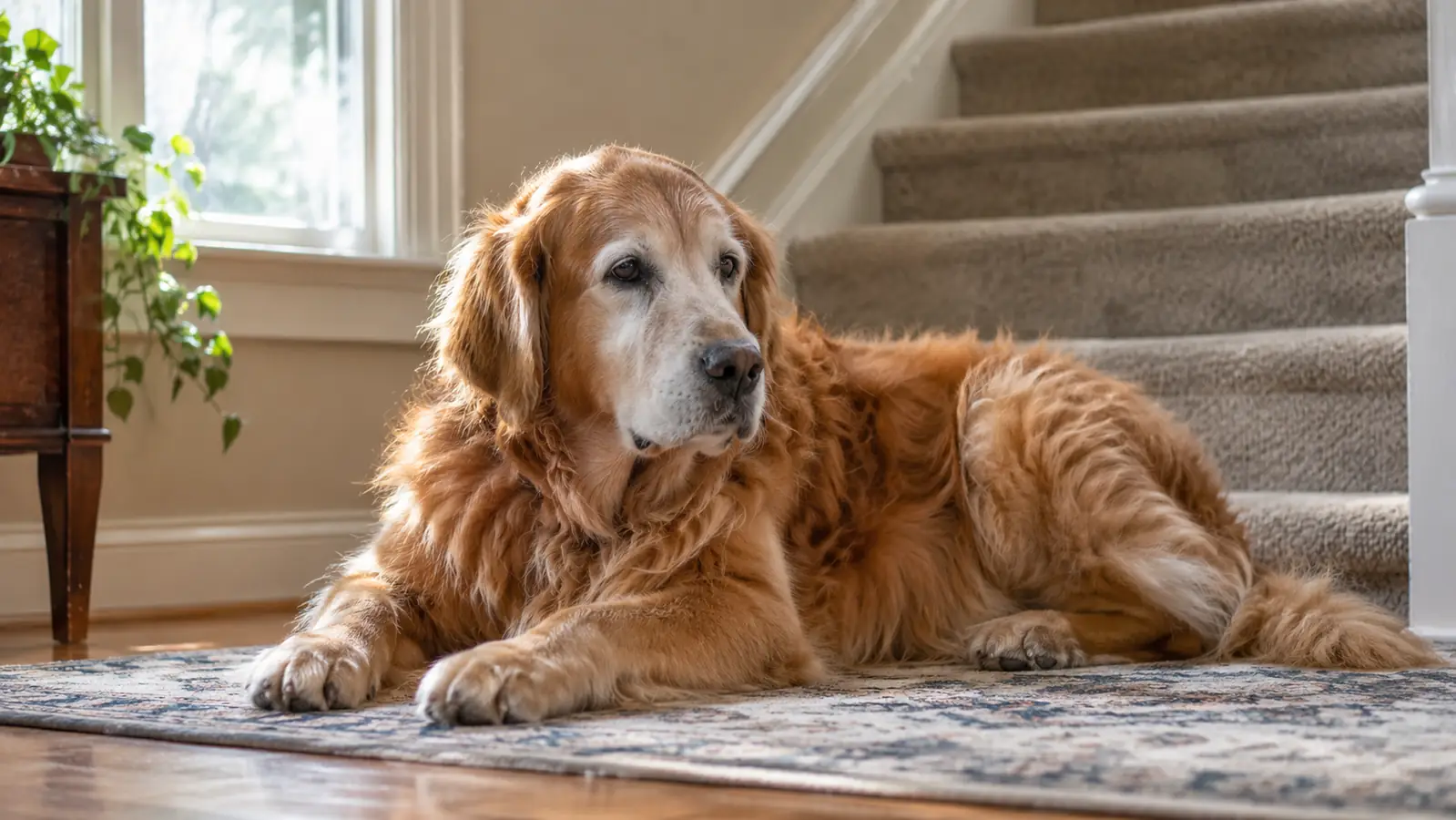
Biscuit is twelve now, a Golden Retriever who still thinks he is four until the hardwood floor reminds him otherwise. He is about sixty-eight pounds, stiff in the back hips, and slowest in the morning and after a long nap. Around age ten he started hesitating at the stairs and at the back of the Subaru Outback. Our vet diagnosed mild hip arthritis at his checkup, and since then I have been the person in this house who reads every label, asks before changing anything, and tries the practical stuff before the fancy stuff. That is how I ended up comparing DOK TigerToes socks with Toe Grips. Both are trying to answer the same question: how do you help a big older dog stop slipping without turning your whole day into a wrestling match?
The short answer is that they solve different parts of the problem. DOK TigerToes are socks with a non-slip grip, and in our house they are the better choice for slick hardwood, for a dog who licks at a paw, and for a dog who needs protection as much as traction. Toe Grips are small nail grips, and they are the better choice for a dog who will not tolerate anything on the paw, for a household that does not want laundry, and for a dog who mostly needs a little more confidence on smooth floors. Neither one treats arthritis. Neither one replaces our vet's advice. They make the floor less of a fight. That is the honest frame.
| DOK TigerToes Socks | Toe Grips | |
|---|---|---|
| Traction on slick floors | Performance grip is built to catch even when the sock twists | Adds traction by giving the nail tips something to grip |
| Paw coverage | Covers the paw and helps with licking and scuffs | Leaves the paw open and covers only the nail tips |
| Airflow and paw feel | Fabric covers the paw, so it holds some warmth | Paw stays open to air and the dog feels the floor |
| Staying in place | Hook-and-loop closure and pull-on fit help keep the sock on | Sits on the nail and needs attention as nails grow |
| Cleaning routine | Machine washable with the dog towels | No laundry at all |
| Senior dog acceptance | Some dogs need a few days to get used to wearing socks | Many dogs forget them once they are on |
| What you get | Four socks in extra large for paws 2.5 to 2.8 inches | A set of small nail grips |
| Best for | Slick hardwood and a dog who needs paw protection | A dog who tolerates nail handling and needs subtle traction |
Where DOK TigerToes Wins
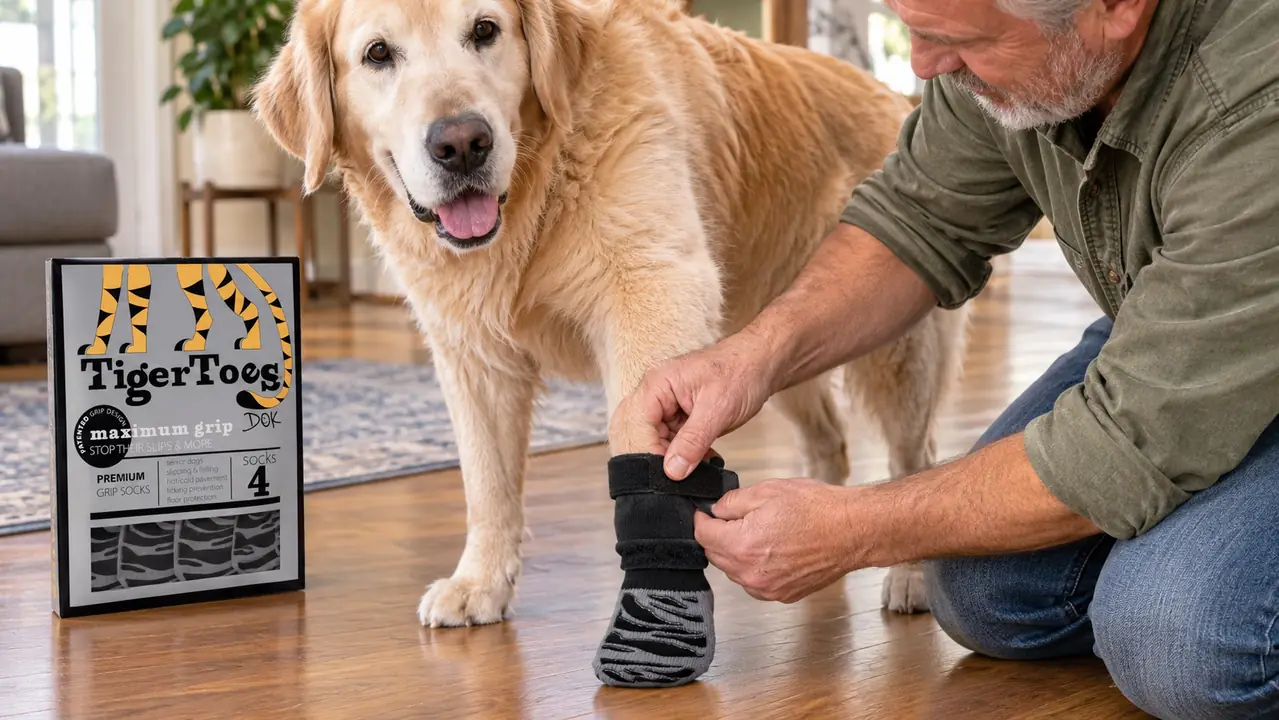
On our hardwood, the DOK socks do the job I actually need done. The grip is the point, and the listing calls it a performance grip built to hold even when the sock twists. In practice that matters because Biscuit does not walk like a show dog. He drags a back paw, he turns tight at the water bowl, and he sometimes ends up with the sock rotated half around. The grip still catches. On the carpeted stairs he does not need them, but on the landing and the kitchen run they give him a steadier step. The extra-large size fits paws 2.5 to 2.8 inches, and the set includes four socks, which is the right number for a dog who will eventually lose one under the couch.
They also protect the paw. The socks are cotton and nylon, machine washable, with a hook-and-loop closure and a pull-on fit. That combination is not fancy, but it is useful. When Biscuit starts licking at a spot on his front paw, the sock covers it and breaks the cycle long enough for me to look at what is going on. I am not using them to treat anything. I am using them to keep him from making a small irritation worse. The closure lets me snug them without fighting a tight cuff over his ankle, and the fact that they go in the wash with the dog towels means I actually keep up with them. The 4.7-ounce weight for the set is light enough that he is not lifting a brick with each step.
One thing I did not expect is that the socks changed how I read his day. When Biscuit is stiff, he plants his feet wider and takes shorter steps, and on a bare floor that wider stance is exactly what makes him slide. With the socks on, the wide stance holds. I noticed it on a cold morning in February, the kind where the heat had been running for an hour and the kitchen floor still felt like a skating rink. He came out of the bedroom, did his usual wide-legged shuffle, and did not scramble once. That is not a cure and it is not a transformation. It is one less moment in the morning where I hold my breath and wait to see if his back end goes out from under him.
Where Toe Grips Wins
Toe Grips win the comfort argument for a lot of dogs. They are small grips that sit on the tips of the nails, so the paw is not covered. Air moves. The dog can feel the floor. For a dog who hates the sensation of fabric between his toes, or who runs hot, that is a real advantage. Biscuit will wear socks, but he is not every dog. I have watched him do the stiff-legged walk for the first minute after I put them on, and a dog who never settles into that is not going to get much benefit from a sock no matter how good the grip is.
Second, there is no laundry. That sounds small until you are the person who owns the washing machine. Toe Grips do not go through the dryer or get lost in a towel load. They also leave the nails exposed, which some owners prefer because they can see the nail and keep up with trims. The tradeoff is that nails grow, and a grip that sits at the tip needs attention as the nail changes. Some dogs also dislike having their feet handled, and applying anything to the nails is still handling. If your dog pulls his foot away when you touch it, the less invasive option on paper may not be less invasive in practice.
What Daily Life With Biscuit Looks Like
Mornings are the test. Biscuit comes off his bed stiff, and the first ten feet across the bedroom hardwood are the worst ten feet of his day. With the DOK socks on, he walks with less of that hesitant tap, tap, tap. He is not trotting. He is not a puppy. He is just less likely to scramble when his back foot hits a slick spot. I put them on before he gets up, which means I am crouched on the floor before coffee, but that is the job. The hook-and-loop closure is the reason I can do it quickly. A pull-on sock with no adjustment would be a fight.
I also learned to put them on while he is still lying down. If he stands first, the back feet take his weight and the whole thing turns into a negotiation. So I kneel on the rug, lift one back paw, slide the sock on, press the closure down flat, and do the same on the other side. It takes about ninety seconds now. The first week it took five minutes and a fair amount of apologizing on my part. The cotton and nylon fabric does not have much stretch to it, which is good for staying on and less good for working over a thick ankle, so I go slow at the cuff and let the closure do the work.
The back deck is the other place I notice it. There are three steps down to the yard, and he has to turn on the landing. The socks do not make him a mountain goat. They do keep him from sliding when he pivots. On the carpeted staircase inside, I take them off. The carpet gives him enough traction, and I do not want him climbing with anything that could catch. That is not a knock on the product. It is just how we use it. A tool is only good if you use it where it helps.
In the Outback, the socks are less useful. The cargo area has a mat, and he mostly needs a ramp or a boost, not grip. I mention it because it is easy to buy a product like this and expect it to solve the whole mobility picture. It does not. The socks help with the floor. They do not help with the height of the vehicle. For that, I use a ramp and I still spot him.
The grip still catches even when Biscuit has twisted the sock half around, and that is the difference between a product I keep using and one that ends up in the closet.
If slick floors are the problem, start with the sock that stays on
DOK TigerToes come in a four-pack for extra-large paws, with a performance grip and a hook-and-loop closure that lets you snug them down. Check the size chart before you order.
Amazon See the DOK TigerToes Socks on Amazon →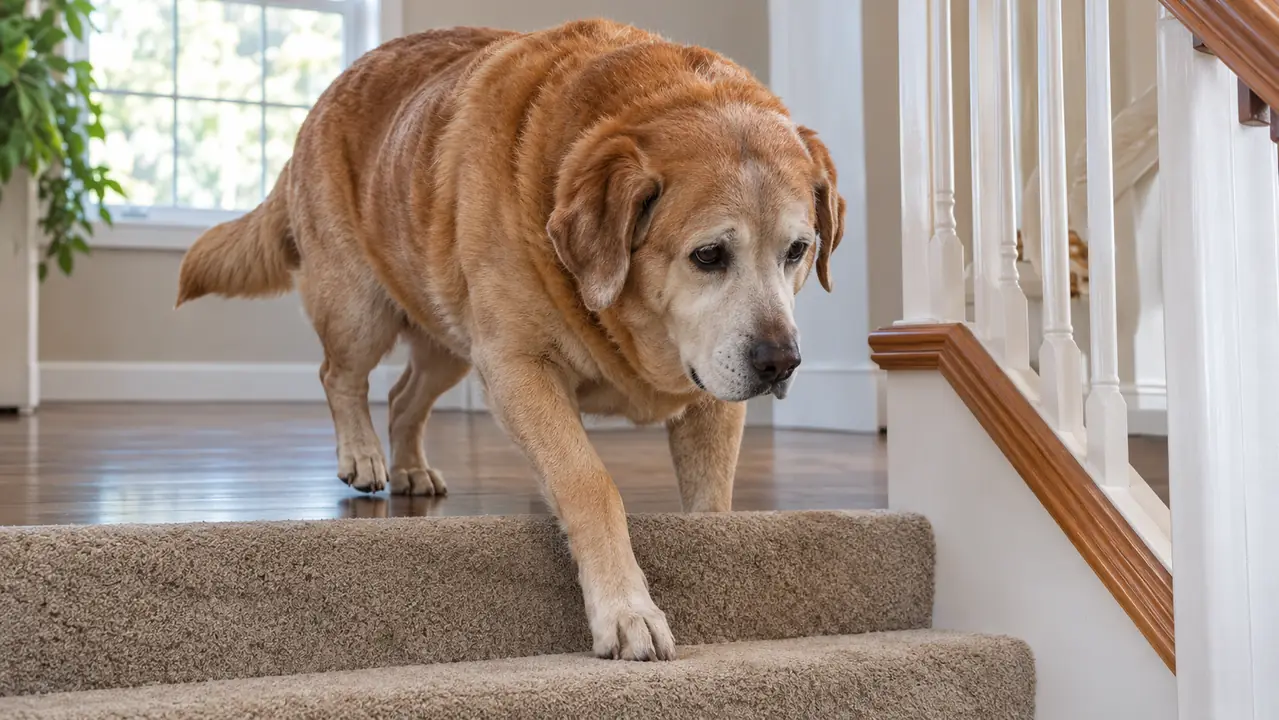
Who Should Buy Which
Buy DOK TigerToes if your dog is slipping on hardwood or tile, if you have already tried a cheap sock that spun around, or if your dog licks at a paw and you need a barrier while you figure out the cause. They are also the better pick if your dog will tolerate something on the paw and you want a set you can wash. The extra-large fit is for paws 2.5 to 2.8 inches, so measure before you order. A sock that is too small is not going to stay on, and a sock that is too big will bunch.
Buy Toe Grips if your dog will not keep a sock on, if you know your dog hates fabric on the paw, or if you want the least visible option. They are also worth considering if you are already comfortable handling your dog's feet and keeping up with nail trims. If your dog snaps or pulls away when you touch his nails, talk to your vet or a groomer before you buy. The right product is the one your dog will actually let you use. One more practical note: neither option is a single purchase that lasts forever. Socks wear at the grip, and dogs lose them under furniture. Nail grips need replacing as nails grow and the surface wears down. I keep two socks in rotation and a spare pair in the closet, which beats buying a whole new set every time one disappears under the radiator. Plan on replacing them eventually.
A Few Things I Learned the Hard Way
Measure the paw, not the dog. DOK gives a range of 2.5 to 2.8 inches for extra large, and that is the number that matters. Biscuit is a big dog, but paw width is not the same as body weight. I traced his paw on a piece of paper while he was standing, which is easier than trying to hold a tape measure against a moving foot. I did it on a Sunday afternoon when he was drowsy and cooperative, and I took three tracings before I trusted the number. His front paws landed right at the top of the extra-large range. His back paws came in a hair under. That told me the size was correct and also told me there was no room to spare, which is exactly what I wanted to know before ordering. A neighbor sized her dog by weight and ended up with socks that rotated on every turn. Weight tells you the dog is large. It does not tell you the foot is wide.
Introduce them slowly. I put one sock on, gave him a treat, and took it off. Then two. Then all four. The first day he walked like he had borrowed someone else's legs. By the third day he stopped noticing. If your dog never stops noticing, that is information. Do not force it. The same goes for Toe Grips. A dog who will not let you near his nails is not a dog who will benefit from a nail grip, no matter how good the concept is.
Ask your vet first if your dog has a diagnosis. I did. Mild hip arthritis is not something a sock fixes. The sock is a floor aid. The vet is the one who decides what else belongs in the plan. That might mean medication, physical therapy, weight management, or a ramp by the car. A pair of socks is a small piece of a larger picture, and it works best when you treat it that way.
The floor is not going to get softer. The sock can.
DOK TigerToes are the pair I reach for on hardwood mornings. Measure your dog's paw, check the size, and see if they fit your routine.
Amazon See the DOK TigerToes Socks on Amazon →