
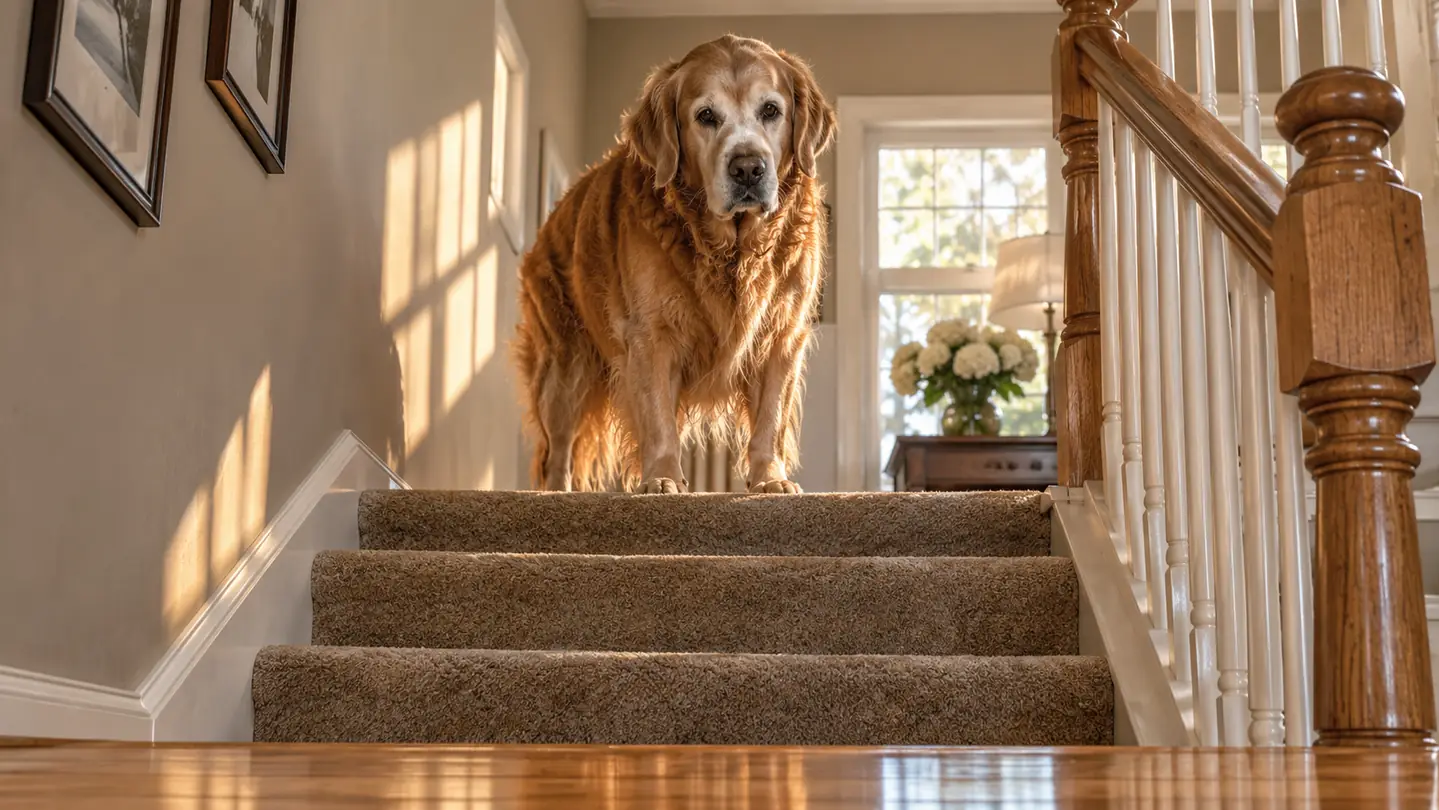
Biscuit stopped at the top of the stairs and did the arithmetic. Twelve years old, sixty-eight pounds, hips that have been stiff in the back since about age ten. The hallway floor is hardwood and the carpet runner does not cover the whole run anymore, so the trip from the bedroom to the back door had turned into a decision instead of a habit. That is the honest reason I bought DOK TigerToes. Not because I thought a sock would do anything for arthritis, but because I wanted the hallway to stop being a negotiation twice a day.
What follows is the honest-review version of that purchase: fit, wear, and what goes wrong. There is a longer dated log elsewhere on this site if you want the month-by-month record. Here I want to cover the parts the product page cannot tell you. The sizing mistake I nearly made. The closure that took me a week to stop fumbling. The rotation that happens on a long day and what it means. And the one job these socks flatly do not do. I will say it up front: they are not a treatment for anything. Our vet manages the arthritis. The socks manage the floor.
The Quick Verdict
Genuinely grippy on hardwood and the only pair Biscuit has not walked out of, but the extra-large fits a narrow paw window and the closure needs daily fussing.
Amazon Check Today's Price →The Extra-Large Fits Paws 2.5 to 2.8 Inches. Measure Before You Order.
That window is narrower than it sounds. Measure the widest part of the front paw while your dog is standing, then check the size chart against that number before you buy.
Amazon Check Today's Price on Amazon →How I've Used Them
Biscuit wears them indoors, mostly. Down the hallway, across the kitchen, out to the back deck where three steps go down to the yard. The pack comes with four socks, which matters more than I expected, because four is exactly enough to have two on the dog and two in the wash. I put them on in the morning before the first trip downstairs and take them off at night. On days when the weather is wet I leave them off for the yard trip and put them back on when we come inside, because wet fabric on a paw is a problem I do not need.
The first week was a negotiation. Biscuit did the thing dogs do, which is lift one paw at a time and look at you as though you have personally betrayed them. I did not make a production of it. Socks on, one piece of kibble, go about my business. By day four the paw lifting stopped. By day six Biscuit was walking to the door at the usual time, wearing them, without the pause at the top of the stairs. That pause was the only thing I was ever measuring, and it is the reason I kept going through the awkward first week.
A rug runner was the first thing I tried, back when the hesitation started around age ten. It covered the hall from the bedroom door to the bathroom and cost less than a vet visit. It also slid on the hardwood itself unless I put a pad under it, and the pad collected dog hair until it was less a pad than a felted mat. Then came a pair of cheap foam toe grips, which Biscuit lost in the yard inside a week. The socks are the third thing, and the only one that stayed in the routine past a month.
I want to be careful here, because this is the point where affiliate reviews tend to overreach. Biscuit still has arthritis. The stairs are still stairs. What changed is that the hardwood stopped sliding out from under a dog who cannot afford a slip. If your dog is hesitating because of pain, socks are not the answer to that and I would not pretend otherwise. If your dog is hesitating because the floor is slick and slipping hurts, then socks are a reasonable thing to try, and far less involved than replacing a floor.
Fit Is the Whole Ballgame
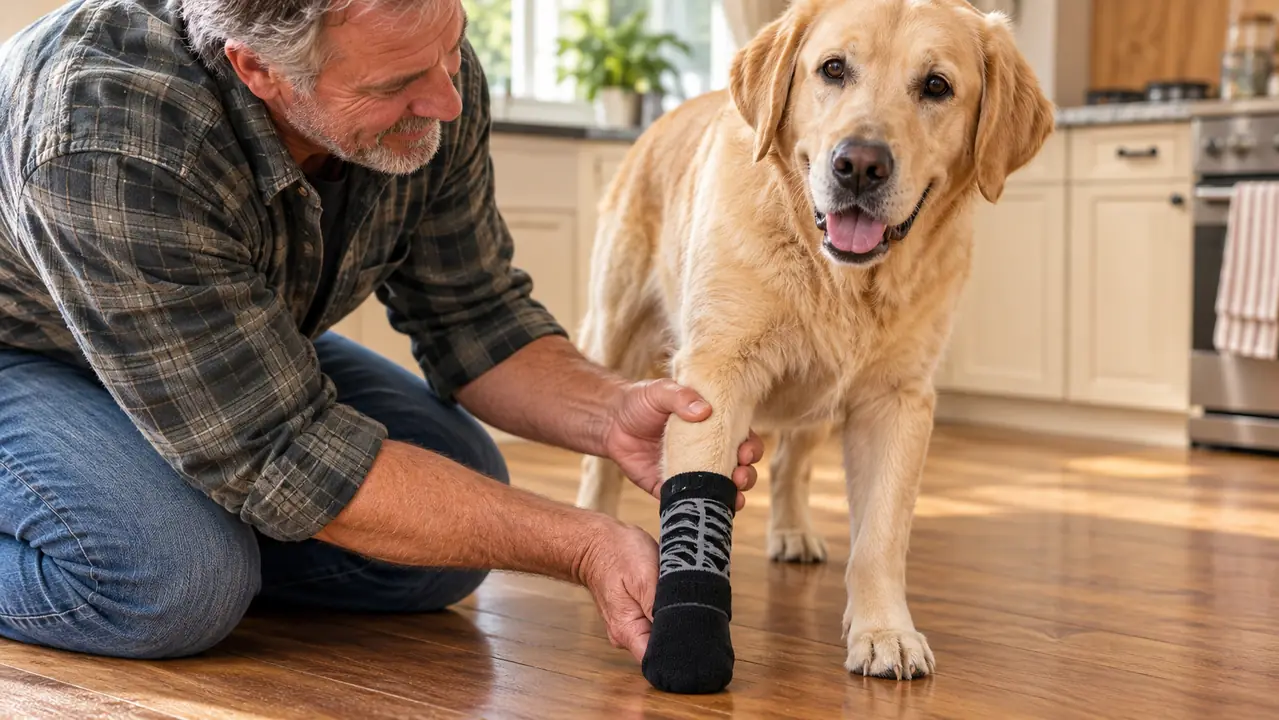
The extra-large is listed for paws between 2.5 and 2.8 inches. That is a narrow window, and three-tenths of an inch is not much room. I measured Biscuit's front paw across the widest part while standing, because a paw spreads when it takes weight and a measurement taken lying down will come out smaller than the sock needs to be. Front paws came in just over 2.6 inches. Back paws a shade under. Both landed inside the window, but not by a lot, and I wrote the numbers on the back of an envelope and kept it in the kitchen drawer for the first month.
I did the measuring on a Saturday morning before breakfast, which turned out to matter more than I expected. Biscuit is up and moving at that hour but not yet tired, so the paw is at its ordinary size rather than puffed from a long day on the floor. I measured three times across two days and used the largest reading, because a sock sized to the small reading will be too snug by afternoon. Tom held a piece of kibble at nose height and I did the measuring. It took both of us and about four minutes, and the envelope with the numbers on it is still in the drawer.
If you land between sizes, that is the real decision point, and I cannot make it for you. Too loose and the sock rotates more than it needs to, gathering fabric under the paw. Too tight and you will see it in the skin above the strap after twenty minutes. The first week I checked the skin every single time I took them off. I would suggest you do the same until you trust the fit, because a dog will not tell you a sock is too snug. They will just get quieter about the whole business.
The DOK socks are cotton and nylon with a hook and loop closure, and they also pull on, so getting one seated is a two-step job: pull it up over the paw, then snug the strap. It took me four or five days to stop putting the strap on crooked. Now it runs about fifteen seconds per paw, which is fast enough that I do not dread it in the morning. Fifteen seconds is the number that decides whether a product like this gets used or sits in a drawer, and it took me a while to appreciate that.
What Actually Goes Wrong
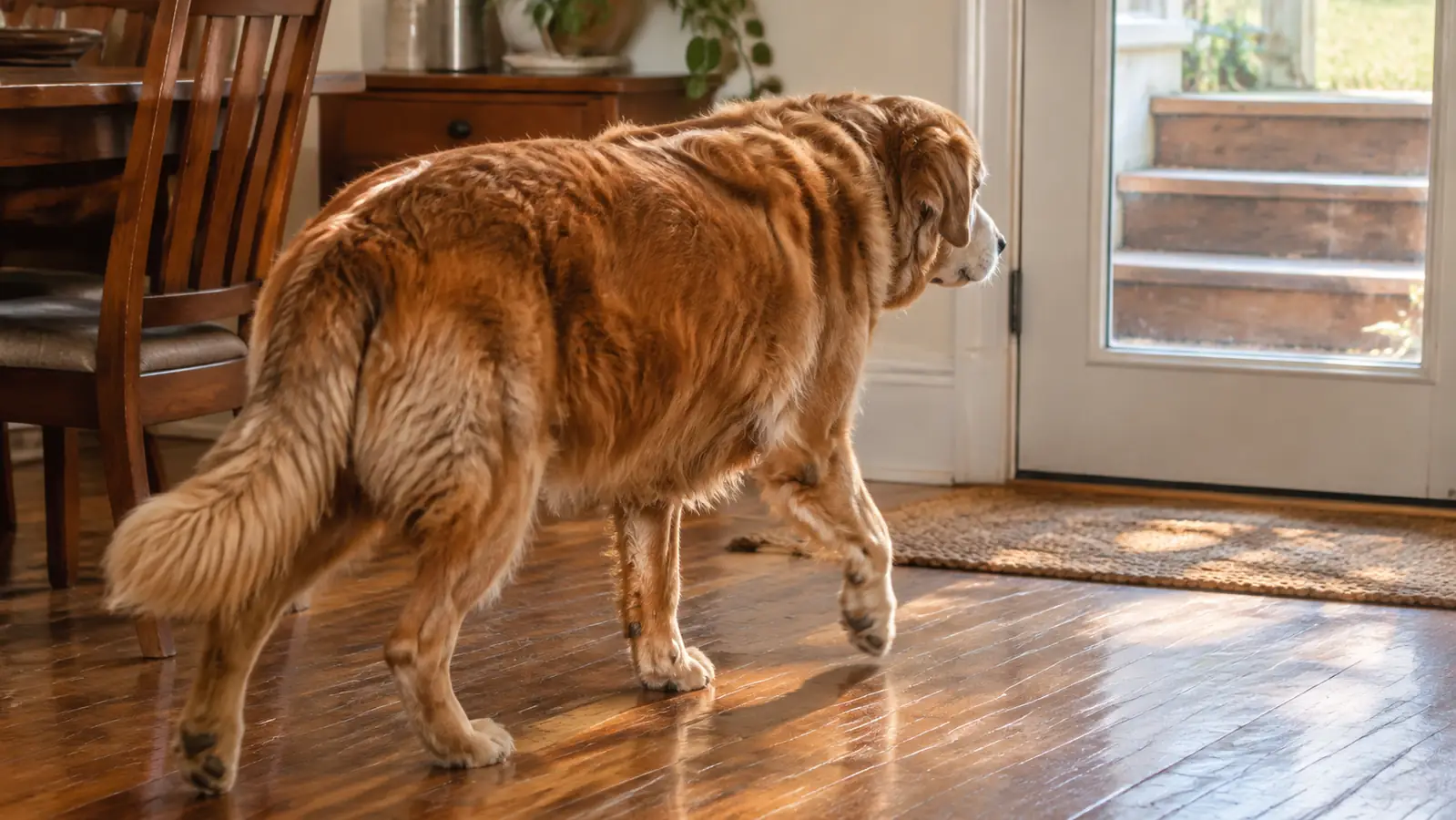
The first thing that goes wrong is rotation. The listing says the grip is built to hold even when the sock twists, and after months of use I believe that as far as traction goes. What it does not mean is that a twisted sock is comfortable. On a long day the sock works around until the grip sits on the side of the paw rather than underneath it, and you will see the dog go a little wide on that leg. The fix is to reseat it, not to buy a different brand. I check all four when we come in from the yard.
There was a Tuesday in April that sums the whole thing up. Biscuit came in from the deck, went down the hall at a decent clip, and the left front sock had rolled so the grip sat on the outside of the paw instead of under it. He went wide on that leg for maybe three steps and then adjusted, which is what a dog with arthritis does, they compensate. I reseated it on the kitchen floor and he was fine. Nothing dramatic happened. But that is the reason I check all four at the door now instead of assuming they stayed put.
The second thing is the strap. Hook and loop collects hair, carpet fuzz, and whatever else lives on a hardwood floor, and once it is fuzzy it stops holding as snugly as it did on day one. I pick the strap clean with a thumbnail every few days. Ten seconds, and it makes a visible difference in how well the closure holds. Nobody mentions this and it is the single most common reason I hear from people who say their grip socks stopped working after a month.
The third thing is the licking, which is a little ironic given the socks are partly sold to prevent it. Biscuit spent the first two evenings trying to nibble them off. That stopped once the socks stopped being interesting. But if your dog is a determined chewer, understand what you are buying: these are fabric. They will not survive a dog who has decided they are a toy, and no amount of grip engineering changes that.
Fourth, and this is the boring one: four socks is not a spare set. It is two on and two off. If one disappears under the couch for a week you are down to three, which means a mismatched pair or a wash cycle run early. I ordered a second pack for exactly that reason and I would do it again. Two packs also means you are never waiting on laundry to protect the hallway, which is the whole point of buying them in the first place.
By day six Biscuit was walking to the door without the pause at the top of the stairs. That pause was the only thing I was ever measuring.
Wear, Washing, and How Long a Set Holds Up
The pack weighs about 4.7 ounces, which tells you the fabric is not heavy, and the care instructions say machine wash. I run them through with a regular load and let them air dry on the counter, mostly because I have lost things to a dryer before and I am not inclined to risk a set. The cotton softens after a few washes, which I actually prefer. The nylon is what holds the shape, and it has held so far.
I wash them twice a week, Sunday and Wednesday, which works out to somewhere around fifty wash cycles since the first pack came in. The cotton has pilled slightly at the heel opening, the kind of pilling that looks worse than it is. The seam along the top has held without a single repair. What I actually watch is the grip itself, because if those dots go smooth the whole purchase stops making sense. So far they have not. I check by running a thumb across the sole of the sock. When it starts feeling like plain fabric, that set is done.
The honest wear pattern after months of daily use shows up in two places: the closure, and the opening at the heel where a paw goes in. The body of the sock has held up. The grip itself has not gone smooth, which surprised me given how thin the whole thing is. If I had one complaint about long-term wear it is the strap, which is the part doing the most work and the part most likely to look tired first. That is not a knock on DOK so much as a fact about hook and loop in a house with a shedding dog.
One thing worth flagging: the dimensions on the listing are 7.8 by 3.25 by 0.25 inches, and that is the sock laid flat, not the paw it fits. I have seen people read that as sizing information and get confused. Use the paw measurement, 2.5 to 2.8 inches for the extra-large, and ignore the flat dimensions unless you are checking whether a sock will fit in a drawer.
What I Liked
- Grip holds on hardwood even when the sock rotates, which is the thing that actually matters
- Four socks per pack means two on the dog and two in the wash
- Machine washable, and the cotton softens rather than stiffens
- Simple enough to put on that a daily routine survives past week two
- Useful for indoor and outdoor protection around the deck and the yard
Where It Falls Short
- The extra-large paw window is narrow, so measure carefully
- Hook and loop picks up hair and needs cleaning every few days
- Socks rotate on long days and need reseating
- Fabric will not survive a determined chewer
- Four socks is not a spare set, so most people end up buying two packs
What Nobody Tells You Before You Buy
Socks do not replace nail trims. A dog with long nails will still click and slip on hardwood, and the nail pushes the sock forward from the inside, which makes the rotation worse. If it has been a while since a trim, deal with the nails first and then judge the socks. I learned this the ordinary way. Biscuit was due, I put the socks on anyway, and spent two days wondering why the front pair kept sliding down before it occurred to me to look at the actual cause.
Socks are not boots. The listing covers indoor and outdoor protection and they are fine for the deck and a dry yard. I would not send a dog down a gravel driveway in them. That is not what they are for, and treating them as footwear rather than floor grip is how you end up disappointed in a product that was never claiming to do that job.
A dog wearing socks indoors in an Asheville July will have warmer feet. Biscuit runs hot in the summer, and I take the socks off more often between June and September. It is not a defect, it is fabric on a paw, but it is worth knowing if your house runs warm or your dog already pants on the kitchen tile.
And the biggest thing nobody tells you: these only help if they are on. A dog who wears them two days out of seven is a dog slipping on hardwood five days out of seven. That sounds obvious written down, and yet it is the reason most people conclude grip socks did not work for them. It is a routine problem, not a product problem, and the DOK set is easy enough to put on that the routine is genuinely achievable, which is the most useful thing I can say about it.
Who This Is For
This is for the owner of a large senior dog who has started hesitating on hardwood, tile, or the stairs, and who wants to reduce slipping without a renovation. It is for the dog that splays a little on the kitchen floor when turning. It is also for a dog recovering from a paw issue who needs to leave the paw alone, since the socks cover the paw and make it less interesting. If your dog is inside the 2.5 to 2.8 inch paw window in the extra-large and you can commit to putting four socks on every morning, this is a reasonable, low-risk thing to try.
Who Should Skip It
Skip it if your dog will not tolerate anything on their feet after a genuine two-week try, because forcing it is worse than the slipping. Skip it if your dog chews fabric, because no sock wins that argument. Skip it if the paw measures well outside the extra-large window, since the fit is the entire product. And skip it if what you are hoping for is arthritis treatment. Grip socks support a dog on a slick floor. They do not treat a joint, and our vet is the one who handles that part. If the floor is the problem, these help. If the joint is the problem, call your vet first.
Measure the Paw, Then Decide: The Extra-Large Is a Narrow Fit
If your dog measures between 2.5 and 2.8 inches across the standing front paw, the extra-large is the right starting point. If not, size down or wait. Fit is the whole product.
Amazon Check Today's Price on Amazon →