
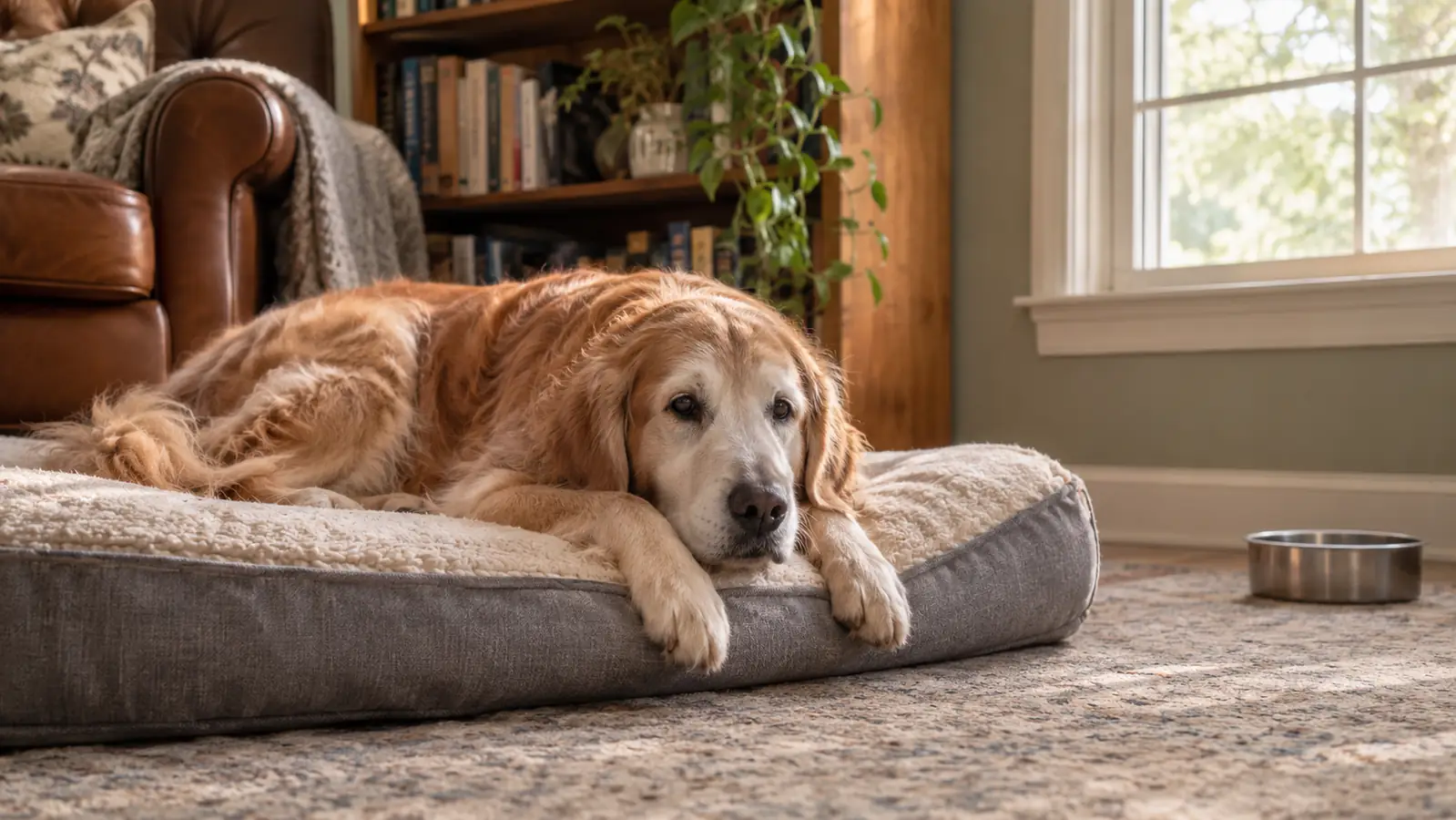
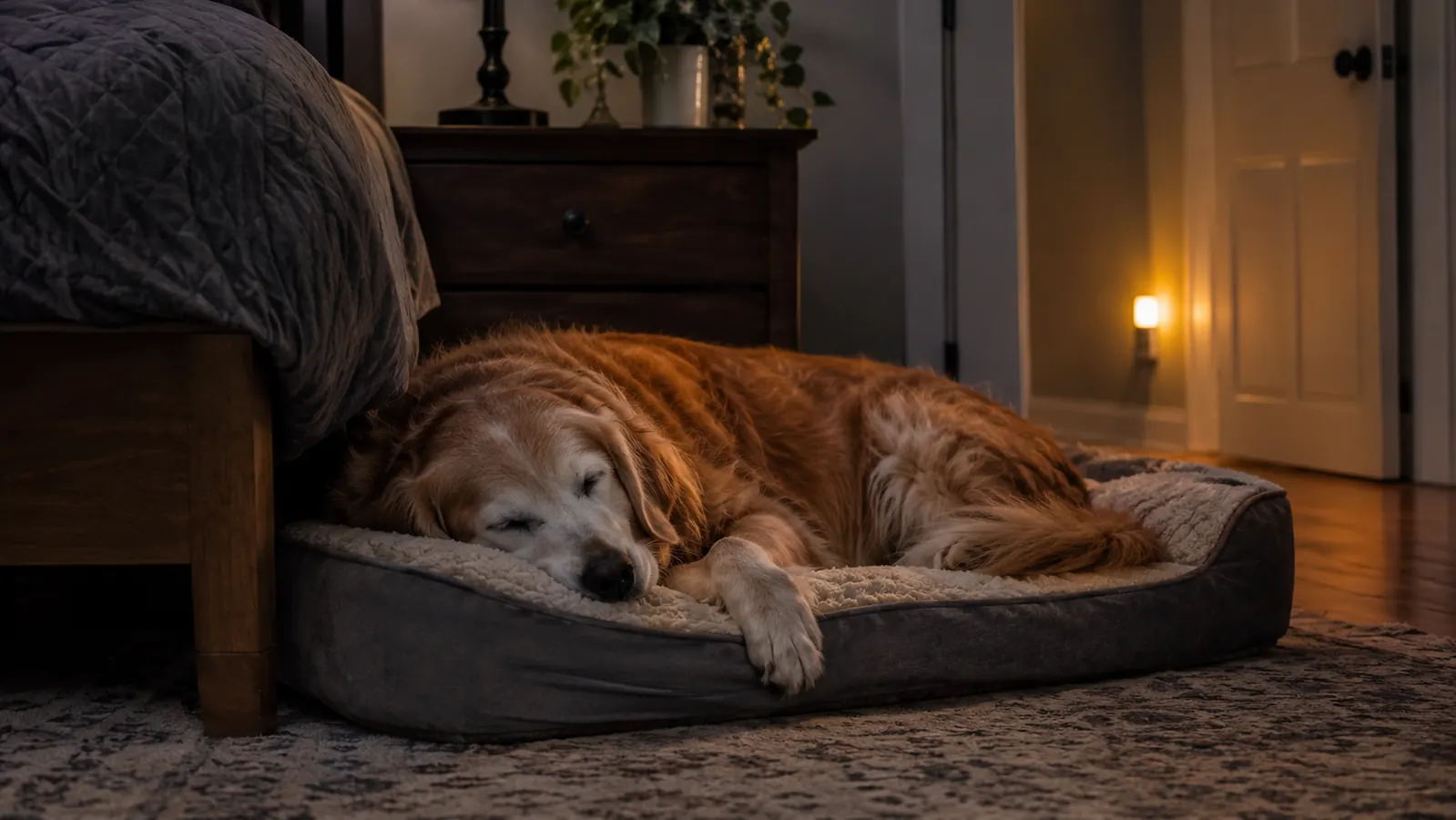
Biscuit started waking me at two in the morning. Not to go out. He would stand beside our bed, shift his weight from one back leg to the other, lower himself onto the hardwood, and grunt. Then he would do it again an hour later. He is twelve, a Golden Retriever, about sixty-eight pounds, and our vet found mild hip arthritis in him when he was ten. The dog was not being difficult. He was uncomfortable, and the floor was not helping. That is the whole reason I ended up reading every listing for an orthopedic bed that would fit him, and why the EHEYCIGA orthopedic bed in the 44 inch extra large size ended up on our floor.
Here is what I learned, mostly by getting it wrong first. A bed is not a cure, and it will not talk a stiff dog out of stiff hips. What a good bed does is take the pressure off the spots that hurt when a heavy body settles, so the dog can stay down long enough to actually rest. Getting that to happen at night takes more than buying the bed. You have to measure, choose a spot, let the foam come back up, teach the dog it is his, and change a couple of habits. Five steps, and the bed is only one of them.
The bed that got Biscuit off the hardwood at 2 a.m.
Extra large at 44 by 32 inches, memory foam over egg crate foam, with three raised sides for his neck and head. It is the one on our floor now.
Amazon Check Today's Price on Amazon →Step 1: Measure Your Dog Flat, Not Standing
A standing measurement lies to you. When Biscuit stands, he looks like a big dog who needs a big bed, and every sizing chart online agrees with him. When he lies flat on his side, nose to tail, he takes up more length than I expected and less width. So measure the flat dog. Get him on the floor, wait for him to stretch out, and run a tape from the tip of his nose to the base of his tail. Then measure across his widest point, usually the shoulders or the ribs. Write both numbers down.
The EHEYCIGA bed we have is 44 inches long by 32 inches wide and 6.5 inches thick, and the listing recommends it for dogs up to 100 pounds. Biscuit is 68 pounds, so he has room to sprawl without hanging off the edge. That thickness matters more than it sounds. Six and a half inches of memory foam over egg crate foam is enough that a heavy chest and a bony hip sink in rather than bottom out against the floor.
If your dog sits right at the top of a weight range, size up. If your dog is long and thin, measure length first and let width follow. And if your dog is a floor sleeper who stretches out flat every night, look at how the sides are built. Three sided bolsters with one open edge is what lets a stiff dog walk in without stepping over anything on the way.
Step 2: Pick the Spot Before You Pick the Bed
We moved Biscuit's bed three times before it stayed put. First it was in the corner of the living room, which looked nice and was the wrong place. He could not see the hallway from there and would not settle. Now it sits against the wall beside the sofa, where he can watch the room and still be out of the traffic path.
The spot has two jobs. It has to be warm, and it has to be out of the draft. Old joints do not love a cold floor, and a bed shoved under a window in January is a bed nobody uses. Ours is on hardwood, which is why the non skid bottom on the EHEYCIGA bed mattered to me. A bed that slides out from under a stiff dog when he steps on it is worse than no bed at all.
The upstairs question is the one nobody warns you about. Our bedroom is on the second floor, and for a while Biscuit slept in the hall because he did not want to do the stairs twice in one night. We carried the bed up and down for about a month, which is a silly thing to do with a sixty-eight pound dog in the house, and then we gave up and left it upstairs and put a folded quilt where the bed had been downstairs. One bed, two floors, and a lot of carrying until we were honest with ourselves about it.
Step 3: Let the Foam Expand and Air Out
The bed arrives compressed. The listing says to allow 24 to 48 hours after unpacking for it to expand, and that is not a suggestion. Ours spent the first night looking flat, and by the end of the second day it had risen to its full 6.5 inches. If you unroll it at nine at night and put the dog on it at five past nine, you have not given the foam a chance and you will spend the next week convinced you bought a bad bed.
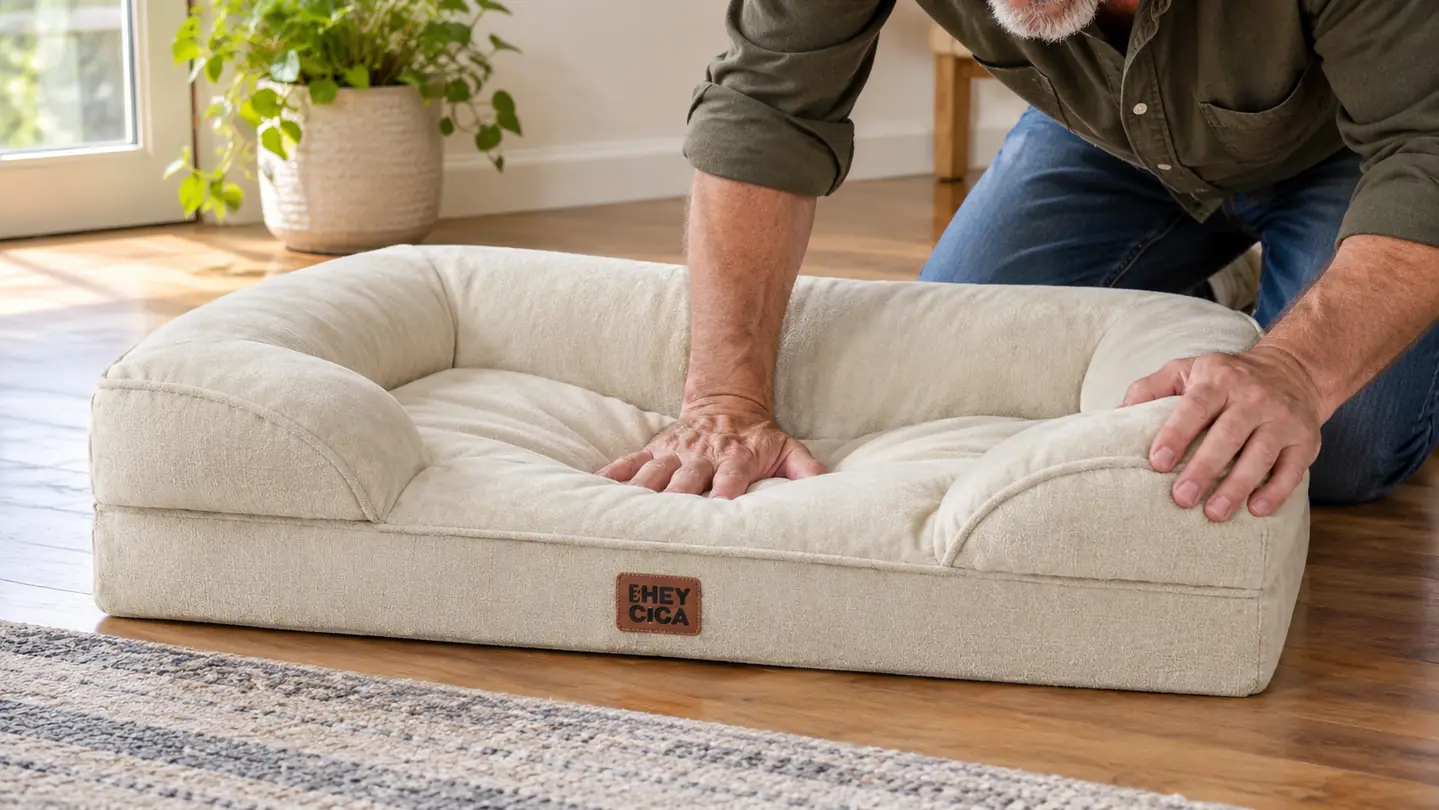
Air it out somewhere with room to breathe. Ours had a faint new smell for a day, which is normal for foam that has been sealed in a box, and it faded on its own. I put it in the spare room by an open window, flipped it once, and pressed a palm into the middle to check that it was springing back instead of staying dented. A bed that holds your handprint is a bed that will hold your dog's hip.
This is also the moment to look at the build. The EHEYCIGA bed combines memory foam with egg crate foam, and the egg crate layer is what gives it that bumpy give under the softer top. There is a waterproof film between the fleece surface and the bottom fabric, which is the part I care about most with an older dog. A twelve year old dog has accidents, and a soaked bed at three in the morning is a bad night for both of you.
Step 4: Teach the New Bed as a Place, Not a Replacement
Dogs do not care that you researched. Biscuit walked around the new bed for two days, gave it a long look, and lay down on the floor next to it. What worked was not coaxing. It was putting a worn t-shirt of mine on the fleece surface, something that smelled like the house, and then sitting on the floor beside the bed while I read.
The other thing that worked was rewarding him for going to it, not for staying on it. I would say his name, pat the bed, and when he stepped on I would hand him a piece of his dinner kibble. Three nights of that and the bed was his. Now he goes to it on his own when the evening gets long, which is what I wanted in the first place.
Do not throw out the old bed in the same week. Keep the smelly old thing next to the new one for a while, even though it ruins the look of the room. I know two people who made a clean swap and ended up with a dog sleeping on the floor out of confusion. Let him choose the new bed because it feels better, which it will, once his hips tell him so.
Step 5: Build a Night Routine Around Stiff Hips
The bed only does half the work. The other half is what happens in the two hours before lights out. A stiff dog who has been asleep on the sofa since seven is going to be at his worst at ten, and a long walk right before bed leaves him sore instead of sleepy.
Our routine is short. Out to the yard last thing, a slow walk around the block earlier in the evening, and no rough play after dinner. If Biscuit has had a hard day, our vet has us keep the harder play in the morning when he is loosest. I am not a vet and I am not going to pretend a schedule treats arthritis. It just makes the night go better than it otherwise would.
The last piece is the room itself. We keep the hallway light on a dim setting so he is not navigating in the dark, and we put the bed where he actually lands when he gets up, not where it looks best from the doorway. And if your dog is up two or three times a night, talk to your vet before you blame the bed. A bed makes it easier to settle. It does not fix a bladder, or a thyroid, or pain that needs managing.
What Else Helps
A bed is one part of a bigger picture, and I would be lying if I said it was the only thing that changed our nights. Floors matter. We put a couple of inexpensive runners down the hallway and at the top of the stairs, and the difference in how confidently Biscuit crosses a room was immediate. Slick hardwood is hard on a dog who is already guarding his back legs.
Ramps and steps help if your dog still wants the couch or the car. We use a ramp for the Outback now, since Biscuit stopped jumping into the back around age ten. The stairs in our house are carpeted, which helps him get a grip, and we go up and down together rather than letting him do it alone and then pretending we did not notice.
And keep the weight where the vet wants it. Every extra pound on a dog with hip arthritis is a pound his joints carry up the stairs. Biscuit is on a measured scoop twice a day and he is leaner at twelve than he was at nine, which our vet says is the kindest thing we have done for him. The EHEYCIGA bed is a comfort item. The weight, the gentle exercise, and the checkups are the actual work.
Six and a half inches of foam is enough that a heavy chest sinks in instead of bottoming out on the floor. That is the whole difference between a dog who settles and a dog who paces at two in the morning.
Where It Falls Short
Honest notes. This is not a firm bed the way a firm mattress is firm. It is soft on top and springy underneath, and a dog who wants to lie on something rigid will not be fooled. It is also not chew proof. The fleece surface will not survive a determined puppy, and ours has only held up because it is used by an old dog who stopped chewing things years ago.
It is not a medical device either, and it does not replace whatever your vet prescribes for pain. And for a dog well over the 100 pound recommendation, or a very tall dog who likes to stretch out to full length, 44 inches is not going to be enough no matter how good the foam is. Measure first. That advice is the whole reason this article has a step one.
If your dog is up at 2 a.m., start with the floor
Biscuit's bed is the EHEYCIGA orthopedic bed in the 44 inch extra large size, memory foam over egg crate foam with three raised sides. Give the foam the full 48 hours before you judge it.
Amazon Check Today's Price on Amazon →