
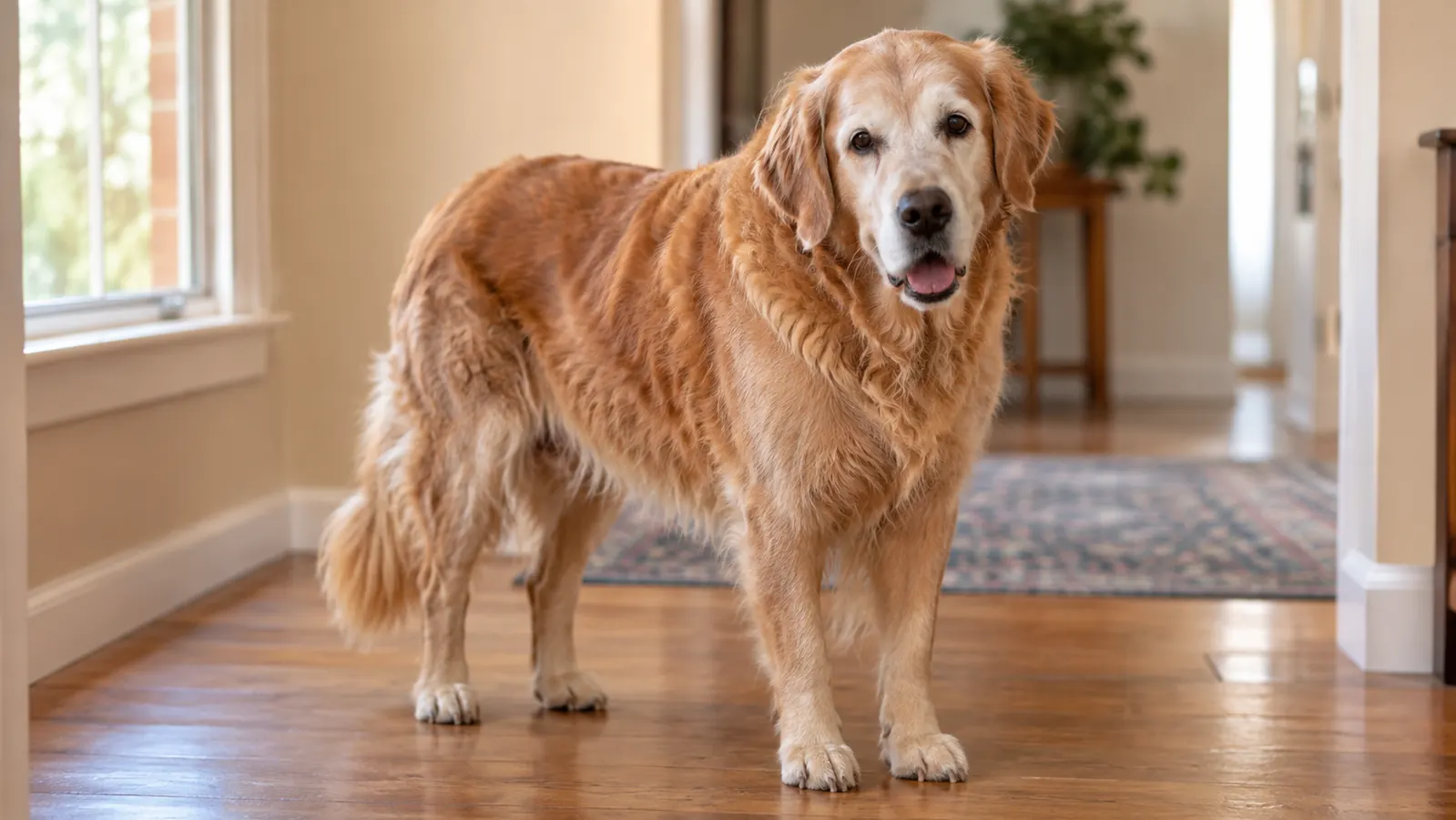
Biscuit is twelve now, a Golden Retriever who weighs about sixty-eight pounds, and the hallway floor in our Asheville house has become the enemy. He does not fall, exactly. It is worse than that, because it happens in slow motion. One back foot slides out from under him, he scrambles to get it back, and then he stands still deciding whether the trip to the kitchen is worth the risk. Some mornings it is not. What finally got him walking again was a set of DOK TigerToes grip socks and the slow, unglamorous measuring routine that made them stay on his feet.
I want to be plain about what that means, because I read a lot of product pages before I bought anything and most of them promised more than a sock can deliver. A sock does not treat arthritis. It does not rebuild a hip. What it does is give an old dog something to push against on a floor that has stopped giving him any purchase, and on a dog this age that turns out to be a real quality of life difference. Our vet called it mild hip arthritis when Biscuit was ten. Back then it was stiffness in the morning and a slow first lap around the yard. Two years later the hardwood is the thing that changed his day. He hesitates at the top of the stairs, he hesitates at the back of the Outback, and he hesitates at the edge of the living room rug, which tells you he has been thinking about this floor longer than I have. We tried a runner in the hall and he walked around it. We tried a bath mat in the kitchen, and it slid, so now the mat and the dog were both sliding. We tried the stick-on paw pads, which lasted about a day and a half on a dog who goes out to the yard four times a day. Trimming his nails on schedule helped a little, which is not the same as helping. What got my attention was watching him cross the living room low and careful, like the floor might open up. That is not a comfortable dog. DOK TigerToes were the fourth thing we tried, and they are not the thing that fixed his hips, because nothing on a shelf fixes hips. They are the thing that let him walk across his own house again.
Four socks, one hallway, and a dog who stops bracing for the floor
DOK TigerToes come as a set of four, with a hook and loop strap that keeps them where you put them and a grip DOK says keeps working even when the sock twists. The Extra Large fits paws 2.5 to 2.8 inches, which is where a sixty-eight pound Golden usually lands. Measure first, then order.
Amazon Check Today's Price on Amazon →Step 1: Measure the paw, standing, not the dog
Do not guess from body weight and do not measure the leg. Measure the paw itself, with the dog standing and his weight on it. A paw spread out on the floor is wider than a paw you lift up in the air, and that difference is the difference between a sock that fits and one that spins off in the hallway. DOK lists the Extra Large at 2.5 to 2.8 inches across the paw, and that number is the only one you need to compare against. Put a piece of paper on the floor, set the paw on it, mark the widest point across the pads, and measure between the marks.
I measured Biscuit twice, once standing and once lying down, and got about a quarter inch of difference. The standing number is the honest one. Measure a back paw, because on a lot of dogs the back feet run wider than the front, and the back feet are the ones sliding out from under him anyway. Ours landed in the middle of the range. All four socks in the pack are the same size, so one good measurement covers every foot.
A stiff senior dog will not hold still for this indefinitely. I did ours on the rug rather than the hardwood, with a treat in front of his nose and my forearm under his belly for balance. It took ninety seconds, and he got a piece of chicken for his trouble, which he now expects every time the paper comes out.
Step 2: Put the sock on a dog who is already lying down
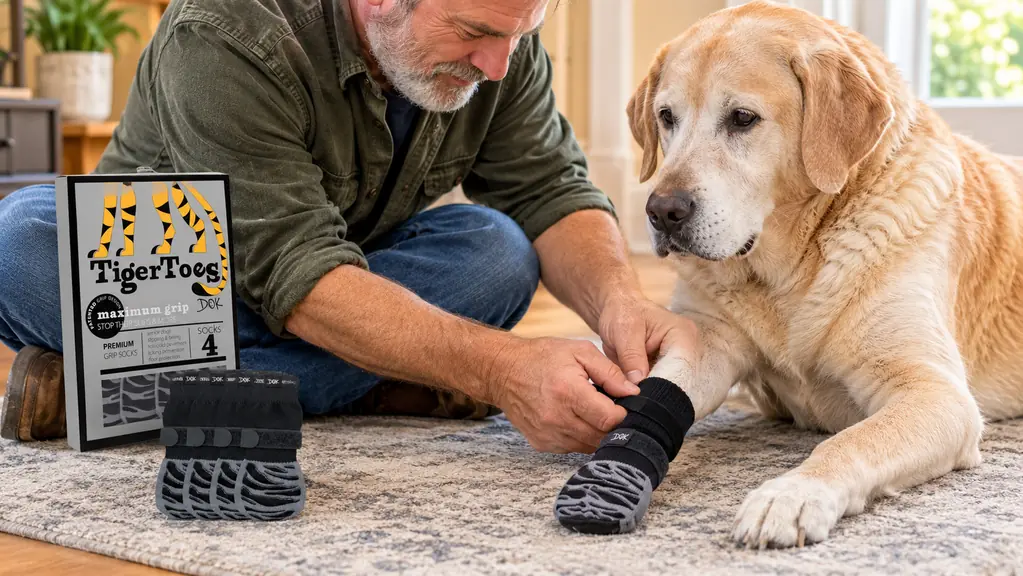
Lifting a back leg on a dog with stiff hips while he stands is asking for a wobble, and a wobble is how you end up on the floor together. So we do it on the ground. I sit with my back against the couch, Biscuit lies beside me, and I start with the back feet, since those are the ones doing the slipping. Front feet are easier on him and I save them for last, when he has already decided to cooperate.
These are a pull-on sock with a hook and loop strap at the top. Open the strap first. Slide the sock over the paw and work it up so the grip sits under the pads where the weight lands, not bunched up around the ankle. Then bring the strap around and fasten it. The first time, Biscuit pulled his foot back twice and gave me a long look about it. The third time I put a smear of peanut butter on a plate on the floor and he forgot he had feet. Now he lies down when he sees the socks come out, which I did not expect and will take full credit for.
Take them off the same way, on the floor, strap first. If you tug a fastened sock off a standing dog you will pull him off balance, and he will remember that the next time you come at him with something in your hand.
Step 3: Fasten the strap snug, then check it twice
The strap is the whole reason these stay on. Too loose and the sock pivots around the paw and works its way off by the time he reaches the kitchen. Too tight and you will see it in the skin above the paw within the hour. My test is two fingers sliding under the strap with a little resistance. Not loose enough to turn, not tight enough to pinch.
DOK says the grip is engineered to keep providing traction even if the sock twists while the dog is wearing it, and I can tell you why that matters. Biscuit drags that right back foot a touch when he is tired, and a dragged foot twists a sock. The first pair I fitted too loosely ended up sideways twice in one afternoon and he still walked on them, which is the point of the design. A snug strap keeps the twisting to a minimum anyway.
Check the straps after ten minutes of walking and again after the first trip outside. Biscuit's loosened on the first day because I was too cautious fastening it. I also take them off before he goes out to the yard, because wet grass and a cotton sock are not friends, and a damp sock has no grip at all. Indoors, on the deck boards, on the porch, they do what they are supposed to do.
Step 4: Build up the wear time before you judge them
The first day, twenty minutes. Second day, an hour. By the end of the first week, Biscuit wore them from breakfast until his afternoon nap, and I was taking them off to check his feet every time he stood up. You are looking for three things: chewing at the strap, a red mark or a rubbed spot above the paw, and that high-stepping march some dogs do when they feel something on their feet.
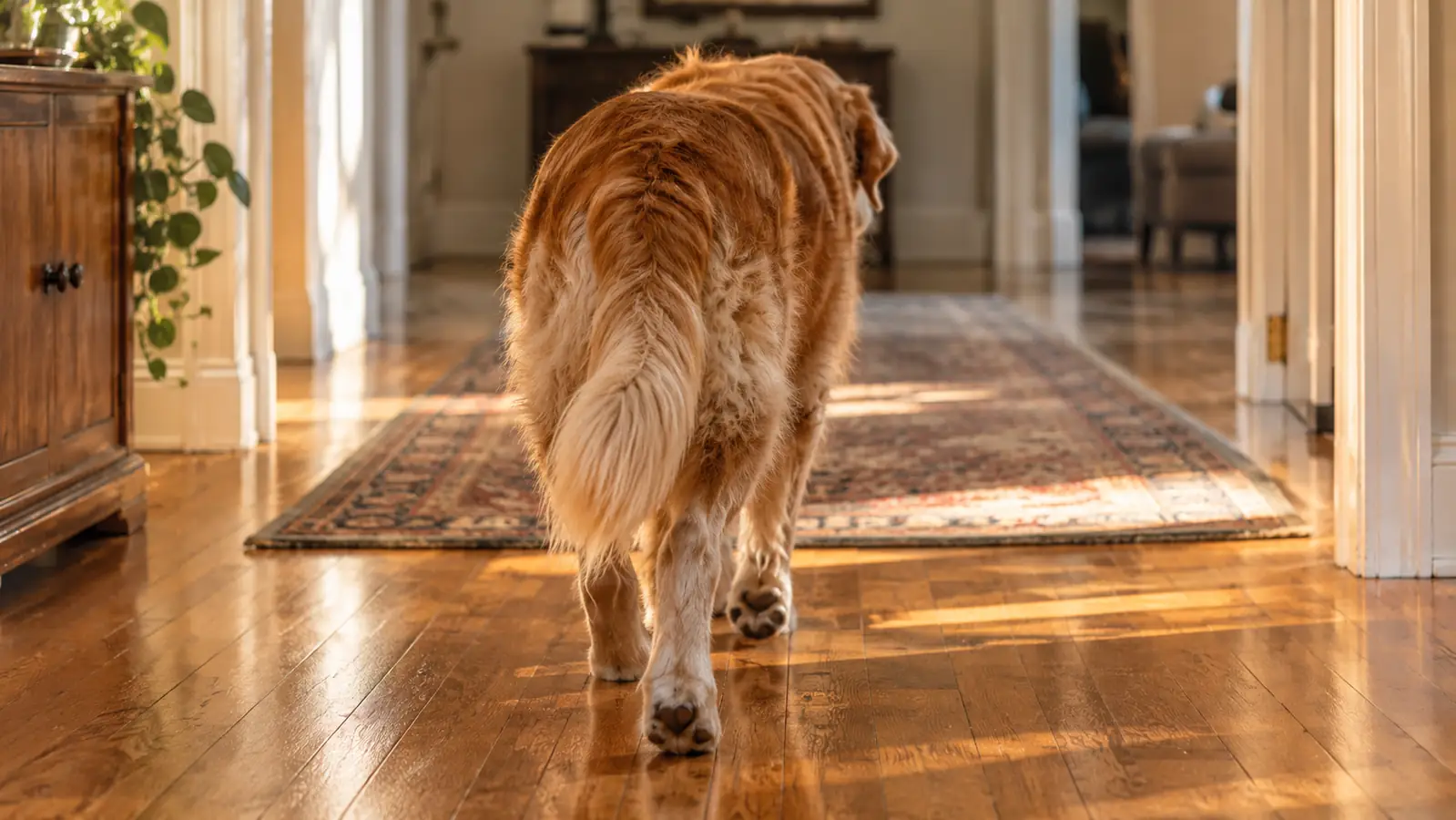
That march is normal and it goes away. Biscuit walked like he was crossing a creek for the first hour. By day three he had stopped lifting each foot so high, and by the second week he crossed the hallway at his normal pace. Not a careful shuffle. Just walking. I had gotten so used to the scrambling sound that the silence was strange.
What they did not do is turn my hardwood into carpet. He still takes the turn at the bottom of the stairs a little wide. He still needs the rug at the end of the hall, and I still put my hand under his belly when he gets up from a long nap. The socks gave him traction on the flat, straight runs through the house, which is most of his day.
Step 5: Wash them weekly and keep a second pair in rotation
The care instructions say machine wash, and that is what I do, in a mesh bag so they do not eat the rest of the load. One set weighs under five ounces and the fabric is thin enough that Biscuit does not walk any differently in a clean sock than he does in a dirty one, so there is no adjustment period after laundry day.
The reason to wash them weekly is not smell, it is hair. Grip collects lint, carpet fuzz and dog hair on the underside, and a pad covered in hair slides exactly like a pad with no grip at all. I turn them inside out, rinse the pads under the tap first, then into the machine. Two on the dog, two in the wash, and I am never waiting on laundry while he stands at the edge of the rug.
Check the toe end for wear when you wash them, because that is where nails do the damage. When the grip under the pads goes smooth and shiny, the sock is done, even if the fabric looks fine. Mine lasted a couple of months of daily wear before I retired the first set.
What Else Helps
Socks are one layer of a bigger fix, and I would be lying if I said they were the only thing that changed in this house. The runner in the hall now has a rubber pad under it so it stays put. Our staircase is carpeted, which I am grateful for every single day, and we added a piece of the same carpet at the top landing where he turns. His nails get trimmed on a schedule and I ask the groomer to keep them short rather than pretty.
The bigger pieces came from our vet. Biscuit had a checkup and we talked about his hips honestly, including what to do about pain on his bad days, and I am not going to pretend a sock belongs in that conversation. His weight matters more than anything I can buy, and keeping him lean is the single thing the vet has repeated at every visit. He takes a joint supplement that our vet approved, and I think of it the way I think of the socks: it supports him, it does not treat anything. If your dog is hesitating on stairs or refusing to get in the car, that is a vet conversation first, before it is a shopping conversation.
The last thing I would spend money on is a ramp. Biscuit's hesitation at the back of the Outback started around age ten and it was not going to be solved by grip on a hardwood floor. A ramp for the deck steps and one for the car made more difference to his day than anything else we bought, and I wish I had done it a year earlier instead of lifting him.
Week two, he crossed the hallway at his normal pace. Not a careful shuffle, not a scramble. Just walking. That was the whole test and he passed it.
Start with a measurement, not a guess
The Extra Large fits paws 2.5 to 2.8 inches and every set includes four socks, a hook and loop strap on each, and machine wash care. Measure a back paw with the dog standing, then order the size that matches the number.
Amazon Check Today's Price on Amazon →