
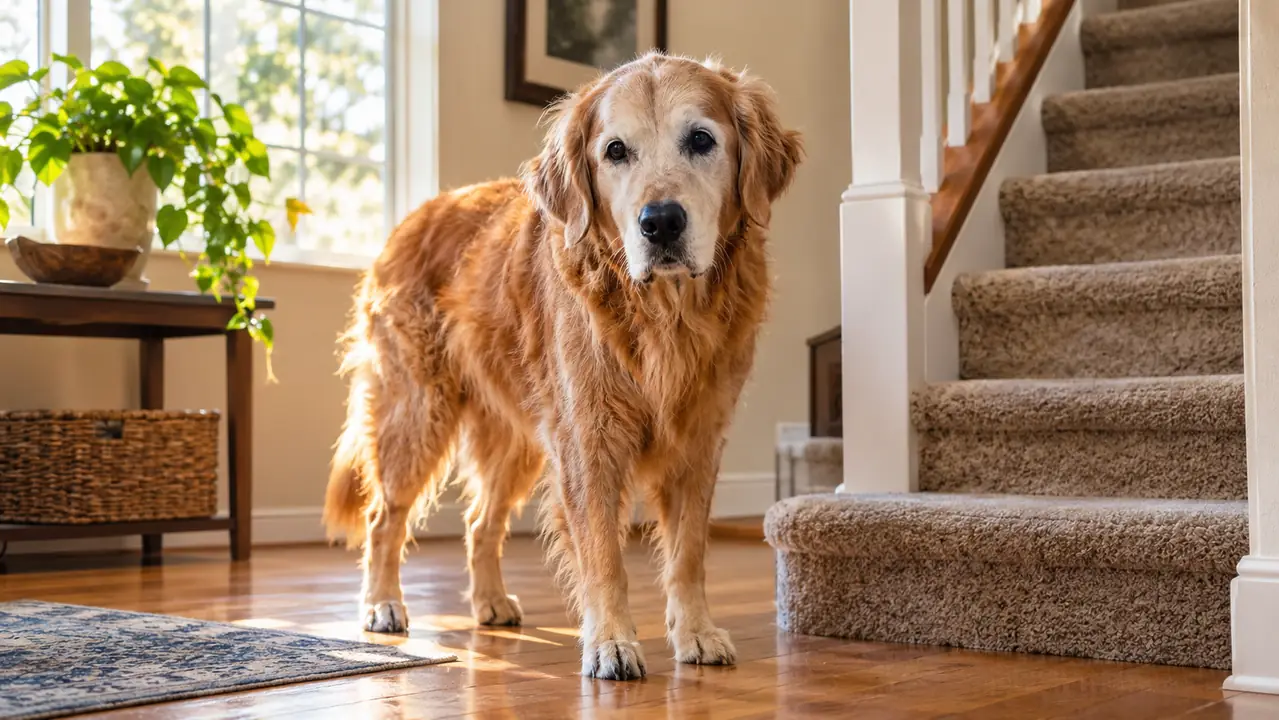
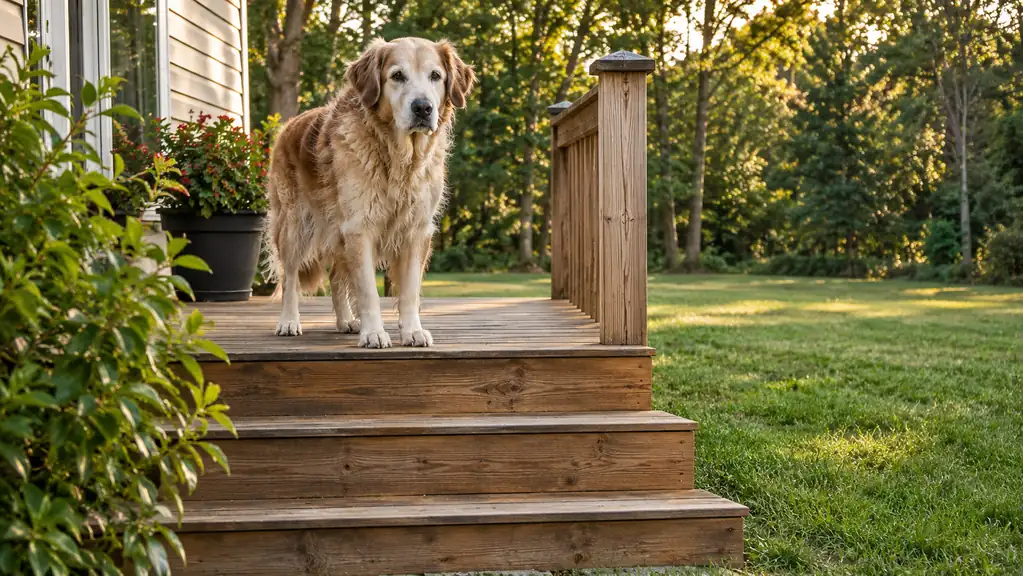
The morning Biscuit quit the deck steps, I was holding a coffee cup and a leash in the same hand, which is how most of our problems start. He stood at the top of those three steps down to the yard, looked at them, looked back at me, and sat down. Not stubborn. Not tired. Just done. He is twelve now, a Golden Retriever around 68 pounds, and our vet called it mild hip arthritis when he was ten. Three steps had been nothing for eight years. Then they were something.
I tried the towel trick first, because everyone tells you to try the towel trick. You slide a bath towel under the belly and lift. It works for about four seconds, then the towel rolls into a rope, your fingers cramp, and the dog gives you a look that says he would rather stay on the deck. That is how I ended up ordering the LOOBANI Dog Lift Harness, an X-Large nylon sling that goes under the hindquarters so a person can take part of the weight while the dog does the walking. I have used it almost every day since it arrived. Here is what that has actually looked like.
The Quick Verdict
Takes real weight off the back end on stairs, thresholds, and into the car. Getting it under a stiff 68 pound dog is a two-hand job, and it is not a ramp, a brace, or a replacement for your vet's plan.
Amazon Check Today's Price →The Three Steps He Stopped Doing Are Why This Lives by the Door
X-Large nylon sling, machine washable, about 15 ounces, folds into its own drawstring storage bag. Measure the widest part of the belly before you pick a size, then check today's price.
Amazon Check Today's Price on Amazon →How I've Used It
Our house is two stories with bare hardwood downstairs and a carpeted staircase, and the back deck has three steps down to the yard. That is the whole geography of the problem. Biscuit can still walk. He can still do the block, slowly, in the cool part of the morning. What he could not do reliably was the up and down: deck steps, the main stairs at night, and the hop into the back of the Outback. Those are the three places a sling has to prove itself, and those are the three places I have tested this one.
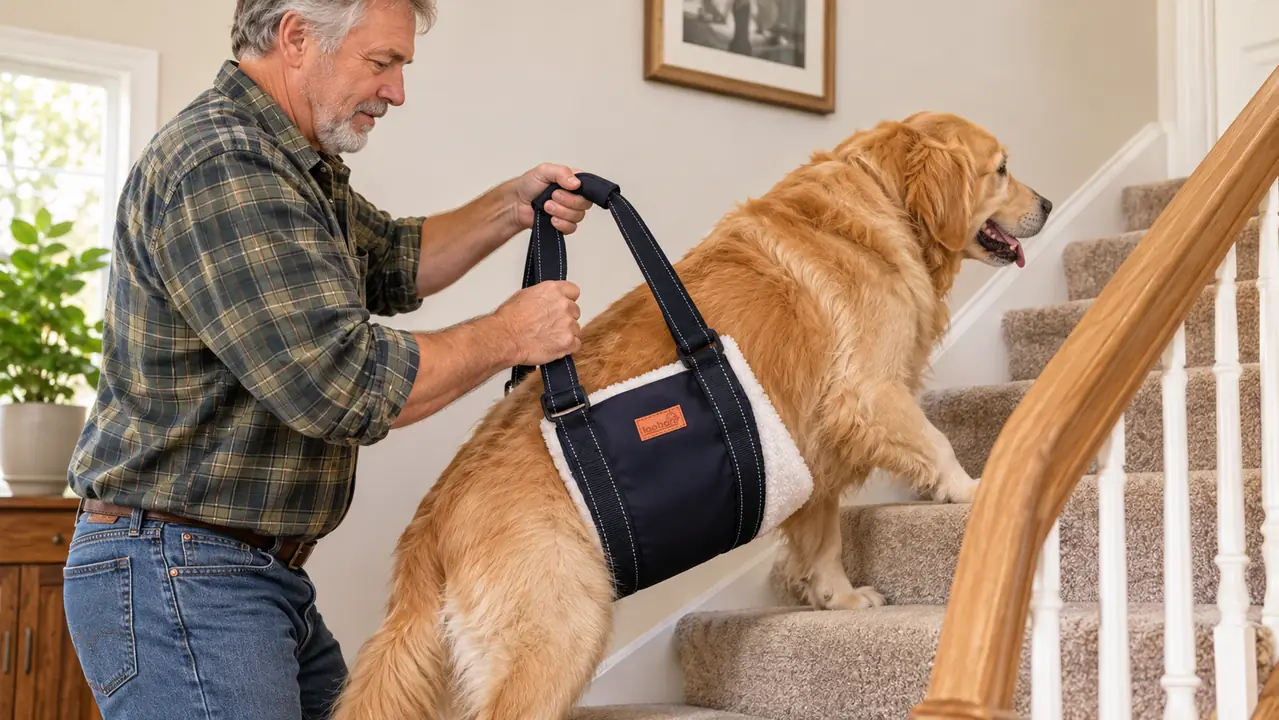
The routine is unglamorous. The LOOBANI sling stays folded on the entry bench, next to the leash hook, because a mobility aid you have to go hunting for is a mobility aid you stop using. When he goes out, I crouch, work it under him from behind, gather both ends, and take up the slack until I feel weight in my hands rather than in his hips. Then we go up or down together at his pace. Roughly half his weight on the bad days, a light steadying hand on the good ones. He does the stairs. I do the balancing.
Mornings are the tell. He sleeps on a thick bed in the living room, and the first three or four steps after he stands up are the worst of his day. That is when the sling matters most, on the short trip from the bed to the back door. By ten he is looser, and by two he is following me around the kitchen hoping I drop something. If you are deciding whether this is worth your money, watch your own dog at the two extremes of the day and you will have your answer.
Six months in, my honest read is that this is a tool for the person as much as the dog. My back stopped hurting on stair days. Tom, who is 67 and does not lift anything he does not have to, will use it without being asked. And Biscuit, who used to plant himself at the bottom of the stairs and wait to be carried, now waits for the sling instead. Same pause, different reason. That is a small thing that turns out to be a large thing.
What the LOOBANI Sling Actually Is
Strip away the marketing and the LOOBANI sling is a band of nylon with a thick padded section that sits under the belly, forward of the hind legs. The closure is a drawstring style, so there is nothing to clip or buckle, which is one less thing to fumble at the top of a staircase. The lining is soft, close to fleece, and the padding matters more than I expected. The first week we used a plain towel and I could see the edge of it digging in. The padded band spreads that pressure out. Nothing about it looks medical. It looks like a piece of heavy webbing with a soft middle, which is exactly what it is.
The nylon is the thick, slightly stiff kind, not the thin strap material you see on cheap leashes. That stiffness is why it does not fold in half under a 68 pound dog the way the towel did. After six months of near daily use the stitching at the ends is intact and there is no fraying along the edges. The padded section has flattened some, which I expected, and it has not worn through. I would buy it again for that reason alone.
It weighs just under 15 ounces and the whole thing packs into a drawstring storage bag that comes with it. Folded, it is roughly the size of a paperback, so it lives in the car under the passenger seat and comes out in the vet's parking lot. It is machine washable, which I have tested more than once, and it has come out of the wash without the padding bunching into a lump. We hang it over the bench to dry. That is the entire maintenance story.
Getting It Under a Big Dog Is the Hard Part
Nobody warns you about this part, so I will. A 68 pound dog with stiff hips does not helpfully step into anything. He stands there like a piece of furniture and waits. In the beginning I tried to do it standing up, one handed, holding the leash in my teeth. That went badly and involved a certain amount of apologizing on my part. What works is crouching behind him, keeping my shoulder low, and sliding the band forward from the back rather than trying to reach under from the side.
The sling itself is not something you clip on in two seconds. It is something you position, then adjust. The first ten times took me close to a minute. Now it takes about fifteen seconds, because we have a sequence and he knows it. He lifts his back leg slightly when he sees me crouch, which is either cooperation or muscle memory. I will take either one.
One thing I would tell anyone ordering: measure before you buy, and measure at the widest part of the belly, not at the waist. Biscuit is 68 pounds and the X-Large is right, with room to spare. A neighbor with a 45 pound cattle dog mix ordered the same size and it swims on her dog. The size chart on the listing is more useful than the weight ranges people quote in reviews. If your dog sits at the upper end of a range, size up. You want the band to sit wide, not dig in.
The Deck Steps, the Stairs, and the Back of the Outback
The deck steps were the first win and the easiest. Three steps, a rail on one side, and I can stand beside him rather than behind, which is safer for both of us. Down is worse than up for him, and it was worse before the sling too. Going down, I take more weight and stay one step ahead and to the side. Going up, he leans into it and I mostly follow. The sling lets me do that without hauling on his collar or scrambling for his back legs.
The interior staircase took longer to trust. Our stairs are carpeted, which helps, and there are twelve of them, which does not. For the first month I used the sling on every trip up at night. Now I use it on the last trip and on mornings when he is stiff, and he does the daytime trips alone. That is not me being lazy. Our vet's advice was to keep him moving under his own power as much as he safely can, and to use support when he needs it rather than taking over.
The Outback was the surprise. Getting into the back had become a two person job involving a running start, and I had started lifting his back end myself, which I should not have been doing at my age. With the sling, I stand at the tailgate, take the weight, and he steps up. It is not elegant. It is one motion instead of three, and nobody ends up with a twisted back. We also use it on the two steps into the vet's front door, which are somehow worse than our stairs.
One small thing that helps and has nothing to do with the sling: a runner rug at the bottom of the stairs. Biscuit's back feet skid on the bare hardwood when he turns, and the skid makes him hesitate, and the hesitation is half the problem. A sling cannot fix that. A rug can, and it cost less than the vet visit that sent us looking in the first place.
Where It Helps and Where It Does Not
It helps with transitions. That is the cleanest way I can put it. Stairs, vehicles, thresholds, a curb, the slippery patch of hardwood where the rug does not reach. It gives you a way to take weight off the hind end for a few seconds at a time, exactly when the dog is least able to manage it. For us that has meant fewer long pauses at the bottom of the stairs and a dog who still goes outside on his own four feet.
It does not help with distance, and it does not fix anything. It is not a brace and it is not treatment. On a long walk it is dead weight in the bag. If your dog's back legs collapse mid stride, a sling under the belly is not going to solve that, and you need your vet, not an Amazon order. I want to be plain about this, because I read a lot of reviews before I bought, and some of them promised things no piece of nylon can deliver.
The other limitation is hands. Both of yours are occupied. You cannot hold a leash, a phone, and the sling at the same time, and you should not try. I clip the leash to my belt loop on stair days. On the deck I just set it down. If your dog is a hard puller on top of being weak in the back, this is not a walking tool and you will want to solve the pulling separately.
One more honest note. The first two weeks I used it too much. It is easy to over help, especially when you are worried, and I was carrying more of Biscuit's weight than he needed me to carry. He got lazy about the stairs and I got a sore shoulder. Our vet pointed out that the point of a LOOBANI sling, or any sling, is to keep the dog using the muscles he still has. Half his weight, not all of it. That correction changed how we use it, and it is the single most useful thing anyone told me.
What I Liked
- Takes real weight off the hind end on stairs, into the car, and over thresholds
- Thick padded band with a soft fleece-like lining, no digging at the belly
- Just under 15 ounces and folds into the included drawstring storage bag
- Machine washable, and the padding survived repeated washes without bunching
- X-Large fits a 68 pound dog with room to spare
Where It Falls Short
- Takes two hands and a crouch to position, slow going at first
- Not a walking aid and not a substitute for a ramp or for veterinary care
- Sizing is not obvious from weight alone, you have to measure the belly
- Your dog has to be willing to stand still for ten seconds while you put it on
Roughly half his weight on the bad days, a light steadying hand on the good ones. He does the stairs. I do the balancing.
Who This Is For
This is for the household with a large dog who can still walk but has started to negotiate. The dog who stands at the bottom of the stairs and thinks about it. The one who needs a boost into the car and then jumps down like nothing happened. If your dog is around 50 pounds or more, still weight bearing, and the problem is a handful of specific transitions, the LOOBANI lift harness is the simplest thing I have found that genuinely changes the shape of the day. It is also for the person doing the lifting, which people forget to count. My back noticed the difference within a week, and I was not the one who needed help.
Who Should Skip It
Skip it if your dog cannot bear weight at all on the back end, because that is a vet conversation and possibly a cart, not a sling. Skip it if you are looking for something to use on walks, because it is not that. Skip it if your dog will not stand still for ten seconds, because you cannot put this on a moving animal and trying is how people get hurt. And skip it if you have not asked your vet what is actually wrong. Biscuit's arthritis was found at a routine checkup. Yours may not be arthritis at all.
If He Is Still Walking, Just Not Up the Steps
The LOOBANI X-Large sling, machine washable, just under 15 ounces, with a storage bag for under the car seat. Measure the belly at its widest point, then check today's price.
Amazon Check Today's Price on Amazon →