

Biscuit is twelve, a golden retriever who still believes he is four, and last winter he started stopping at the top of the staircase and looking back at me as though I had built it wrong. He was diagnosed with mild hip arthritis when he was ten. Our vet's advice has not changed since: keep his weight down, keep him moving, and make the hard parts of his day easier. That last instruction is the one that lands on you at ten at night, when your dog is standing at the foot of the stairs working up to the first step. It is what sent me to the kitchen table with a laptop, reading listings until my eyes crossed. I ended up with the LOOBANI lift harness for large dogs, after two weeks of borrowing a plain webbing hind leg sling from a neighbor. This is what the comparison actually came down to in our house.
The short answer is that they do different jobs and neither one is wrong. A webbing sling is a loop of nylon strap you slide under the hindquarters and lift with. It is inexpensive, it folds into a jacket pocket, and it works. The LOOBANI is the same idea with a wide, thickened panel, a soft sheepskin-like lining, a drawstring closure that holds the panel where you put it, and it goes in the washing machine. If your dog is large enough that lifting him is a two-arm job and you are doing it several times a day, the padding stops being a nicety. If you want something in the glovebox for the occasional trip, a bare strap is a perfectly sensible purchase.
| LOOBANI Lift Harness | Webbing Hind Leg Sling | |
|---|---|---|
| Support style | Wide sling panel supporting the hind legs and hips, held in place with a drawstring closure | A narrow strap looped under the hindquarters, lifted by hand |
| Padding | Thickened panel with a soft sheepskin-like lining against the dog | Bare nylon webbing, no padding at all |
| Staying in place | The drawstring keeps the panel cupped under the dog while you lift | Nothing to adjust, but the strap can slide and bunch as the dog moves |
| Getting it on | You seat the panel and snug the drawstring before you lift | Slide it under and stand up. Nothing to adjust |
| Packing it | 14.88 ounces, comes with a storage bag, takes up a corner of a tote | Rolls up to about the size of a fist and lives in a pocket |
| Cleaning | Machine wash, per the care instructions on the listing | Nothing padded to launder, but nothing labeled either |
| Sizing | X-Large, listed for large dogs with a breed recommendation of all breeds | Usually sold as one adjustable length |
| Material | Nylon | Nylon webbing |
| Best for | Daily lifting on stairs, into the car, and onto furniture for a big dog with weak rear legs | Occasional lifts, plus a small backup to keep in the car or a pack |
Why I Started Looking in the First Place
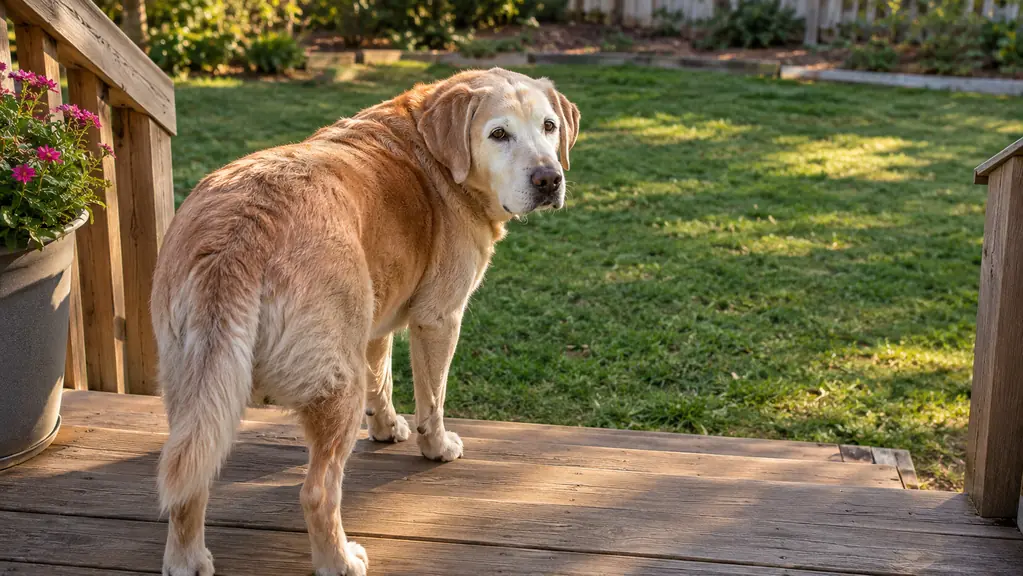
Biscuit is sixty-eight pounds of dog who has never once admitted to being tired. The arthritis announced itself in small ways. He would stand at the bottom of the carpeted staircase a beat longer than he used to. On the hardwood he clicked and slid, back legs going out from under him on the turn into the kitchen. After a long nap his first four or five steps were stiff enough that Tom and I would both stop what we were doing and watch him, the way you watch someone on ice.
The car was worse. The Outback's cargo floor sits at roughly his chest height. He used to launch himself in without a thought. Around age ten he started putting his front paws up on the bumper and then just standing there, waiting, which is a hard thing to watch and an easy thing to fix if you have the right piece of gear. Our vet confirmed the mild hip arthritis at that checkup. She did not hand me a shopping list. She told me to keep him lean, keep him walking, and take the strain off the parts of his day that were getting harder.
The first thing I tried was a webbing sling a neighbor lent me. You have seen them, they are sold under a dozen brand names for very little, and they are exactly what they look like: a length of nylon webbing with a loop for each hand. You fold it, slide it under the dog's hindquarters, and lift. It worked. That is the honest version of the story. It worked, and I used it twice a day for two weeks before I ordered anything else.
Where LOOBANI Wins
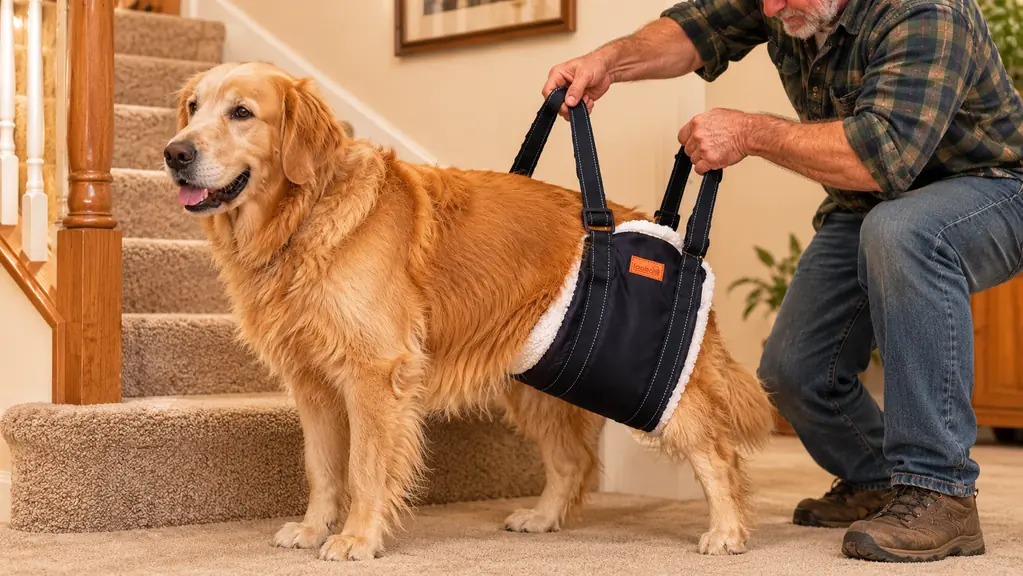
Surface area is the whole argument for the padded version. A narrow strap puts all of the lift into one line across the belly or the hips, and on a sixty-eight pound dog you have to hunt for a spot that does not make him flinch. The LOOBANI panel is wider and it is thickened, with a soft sheepskin-like lining against the dog's skin. That is not a cosmetic difference on an animal with sore hips. Within a few days he stopped shifting away from my hands when he saw me reach for it, which told me more than any listing copy could.
The second thing it wins on is staying put. The closure is a drawstring, and what that buys you is a panel that stays cupped under the dog while you take his weight, instead of sliding forward or bunching to one side halfway up the staircase. With the webbing sling I was constantly re-seating it, one hand on the dog and one hand fishing the strap back into place. On stairs, with a dog who is already unsure, that fumbling is exactly what makes him refuse the next attempt. The LOOBANI also goes in the machine, which matters more than I expected for a piece of gear that lives against a dog's skin and undercarriage.
Where a Webbing Sling Wins
It is faster. There is no panel to center and no drawstring to snug down. You fold the strap, you put it under, you stand up. When Biscuit is waiting at the back of the Outback and I am holding a bag of groceries in one hand, the bare strap is the thing I can manage alone. The LOOBANI takes me a few extra seconds every time, and if you are doing this eight or nine times a day, those seconds add up to something real by Friday.
It also disappears into a pocket, and that is worth more than it sounds. The LOOBANI weighs just under fifteen ounces and comes with a storage bag, which is fine hanging by the door or riding in a tote, but it is not something you forget you are carrying. The webbing sling rolls up to the size of a fist. If you want a sling in the glovebox for the once-a-month vet trip, or in a hiking pack for a long walk that might go wrong two miles from the car, the bare strap is the better travel answer. I keep one in the Outback for exactly that reason, and I would not be without it.
If Your Dog's Day Looks Like Biscuit's, This Is the Version That Stayed
The padded sling with the drawstring closure, the sheepskin-like lining, and the machine-wash care instructions. It is the one that stopped him flinching at my hands and the one that is still on the hook by the door.
Amazon Check Today's Price on Amazon →How It Went on Our Actual Stairs
We have three steps down off the back deck to the yard, and that is where a sling earns its keep. Down is harder for him than up. He takes a step, stops, and thinks about the next one. With the padded sling I can take his weight without yanking, let him find the tread with his back feet, and follow him down at his pace. The first week I used it every single trip outside. By the third week I was using it for the stairs and the car and letting him handle the flat yard on his own, which our vet says is the point. Support the hard parts and let him keep doing the easy ones.
Mornings are the stiffest. He sleeps on the landing and wakes up creaky, and the first trip down is the one he dreads. That is the trip I always use the sling for, even now that he is doing better on the whole. Once he is warm he moves like himself again. I would rather spend thirty seconds on a landing than watch him talk himself out of coming downstairs at all.
The car is the other place it matters, and it took the guesswork out of something that used to embarrass us both. He puts his front paws up on the cargo floor and waits, and I lift from behind until his back feet are up. Tom does it too now, and it is easy enough that he does not grumble about it, which is my real test for any piece of gear that comes into this house.
Down is harder for him than up. The sling let me take his weight without yanking, let him find the step, and follow him down at his own pace.
Sizing, Washing and Other Details
Biscuit wears the X-Large. The listing describes it as sized for large dogs, with a breed recommendation of all breeds, which in practice means you measure rather than guess. My rule for anything that goes under a dog is that the panel should reach across the width of the hindquarters without the edges curling up under him. Ours sits flat. The drawstring is what lets it fit a range rather than one exact shape, and that is why it has kept working on a dog whose hips have changed over the past two years.
It is nylon, it is machine washable, and it has held up. I wash ours roughly every two weeks with the dog towels and let it air dry. The lining has not matted and the stitching at the panel edges has not opened. That is a modest report after a season of use, and modest is what I have got. I would tell you if it had fallen apart, because I have returned plenty of things that did.
It does cost more than a bare webbing strap, and I am not going to pretend otherwise. The question I ask myself about anything in this category is how many times a day it gets used. Ours gets used six or seven times on a normal day. Spread across a year, that changes how the arithmetic feels, and I would make the same choice again.
What a Sling Does Not Do
A sling is a handrail, not a treatment. It does not do anything about the arthritis in Biscuit's hips. It does not build muscle back, and it is not a substitute for the checkup, the weight management, or the short daily walks our vet prescribed. What it does is get him down three steps without a wobble so that he keeps using the steps, which is the thing that keeps everything else working. If you are expecting a sling to fix a joint, you will be disappointed. If you want help with the hardest ten feet of your dog's day, it does that job well.
Who Should Buy Which
Buy the LOOBANI if your dog is large enough that lifting him is a two-arm job, if the weak rear legs are the problem rather than a front-end issue, and if you are doing this several times a day on stairs, into a vehicle, or onto the furniture. Buy it especially if your dog has started to object to being handled back there. The padding and the lining are what ended the objection in our house. At sixty-eight pounds Biscuit sits squarely in the range this sling is built for.
Buy a webbing sling instead if you need something for occasional lifts, if you want a backup that lives in the car, or if you are still in the figuring-it-out stage with a dog who may not need help for long. Some dogs strain a muscle, recover, and never need a sling again. For that, a strap and a decent orthopedic bed make more sense than a padded sling. And if it is the front legs that are going, neither of these is the right tool, so ask your vet what you are actually supporting before you spend anything at all.
One Last Thing Before You Decide
Size it against the width of your dog's hindquarters, not his weight on the vet's chart. The drawstring gives you some room either way, but a panel that curls at the edges is a panel that rubs. If you are between sizes, measure twice.
Amazon See Current Sizing and Details on Amazon →