
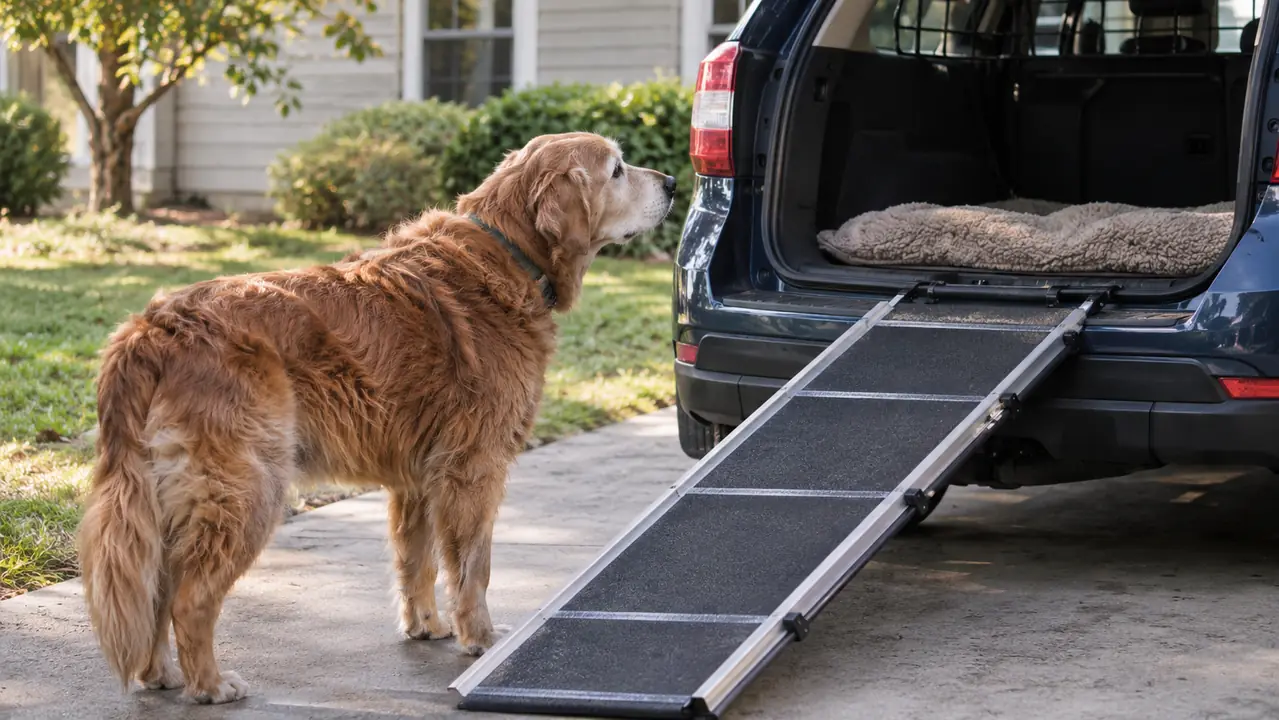
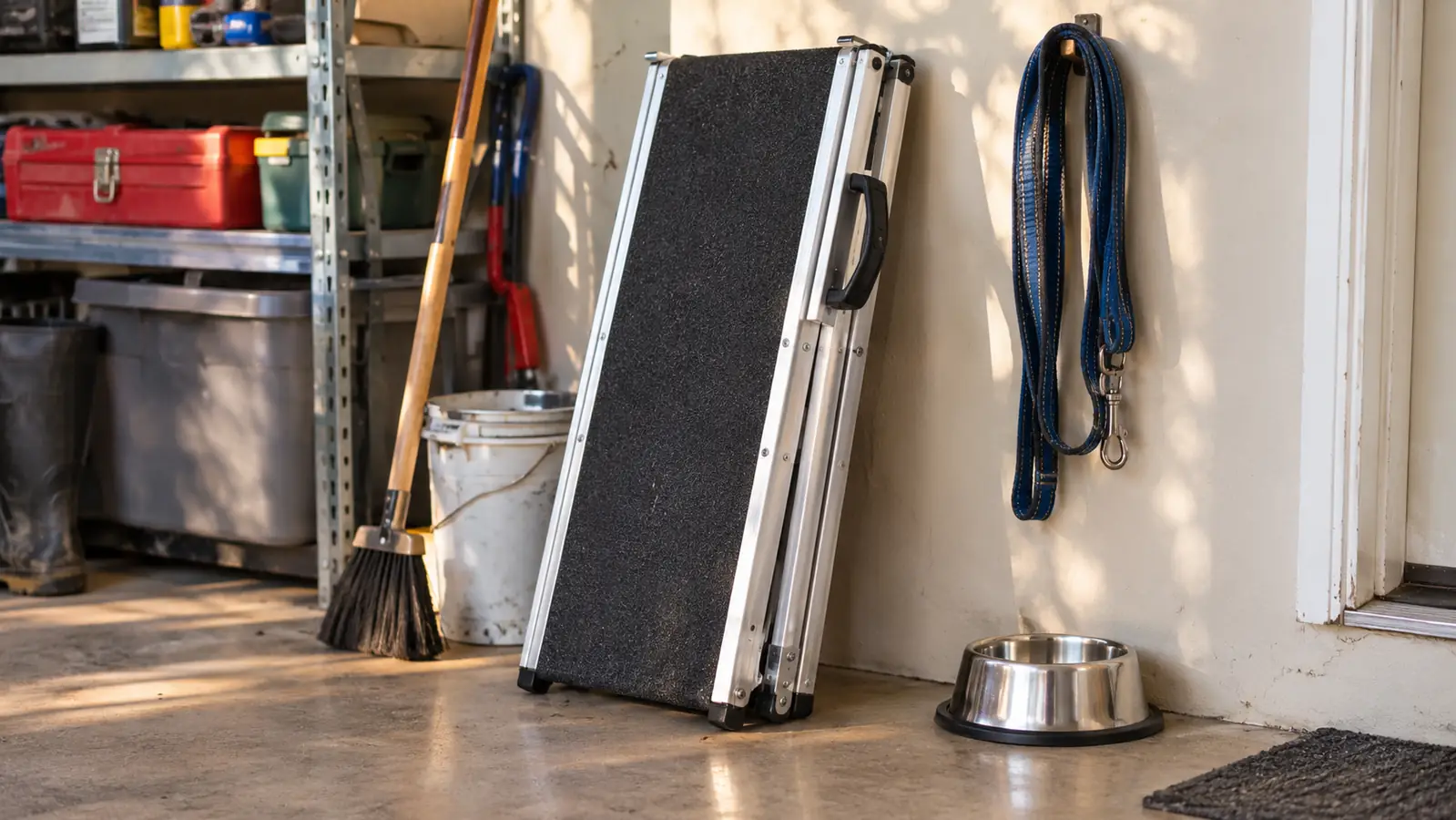
The first time Biscuit refused to get in the back of the Outback, I assumed he was being difficult. He was ten that spring, he had made that jump several hundred times, and there was nothing wrong with the weather. I put my hand under his chest and boosted him up and he scrambled the rest of the way in, then stood in the cargo area with his head down like he had done something wrong. Our vet found mild hip arthritis at his checkup that fall. He is twelve now, sixty-eight pounds, and he does not jump into anything. That is how the PetSafe Happy Ride Folding Dog Ramp came to live in our garage, leaning against the wall next to the broom.
I want to be clear about what this ramp is and is not. It did not treat Biscuit's arthritis. It is not a substitute for the checkups, the weight management, or the joint supplement our vet approved. What it did was remove one small daily argument from our lives. He walks up it. I do not lift him. Both of us are in a better mood at the trailhead. Here is what I have learned in about a year of using it, including the parts I do not care for.
The Quick Verdict
Ten pounds, sixty-two inches, rated for a hundred and fifty. It ended the lifting in our house. It slides on smooth concrete, it flexes a little in the middle, and it takes up real space in the garage.
Amazon Check Today's Price →The ten-pound ramp that ended the lifting in our house
Folds down for storage, rests on the cargo sill, and is rated well past what a sixty-eight pound dog needs. Check today's price on Amazon.
Amazon Check Today's Price on Amazon →How I've Used It
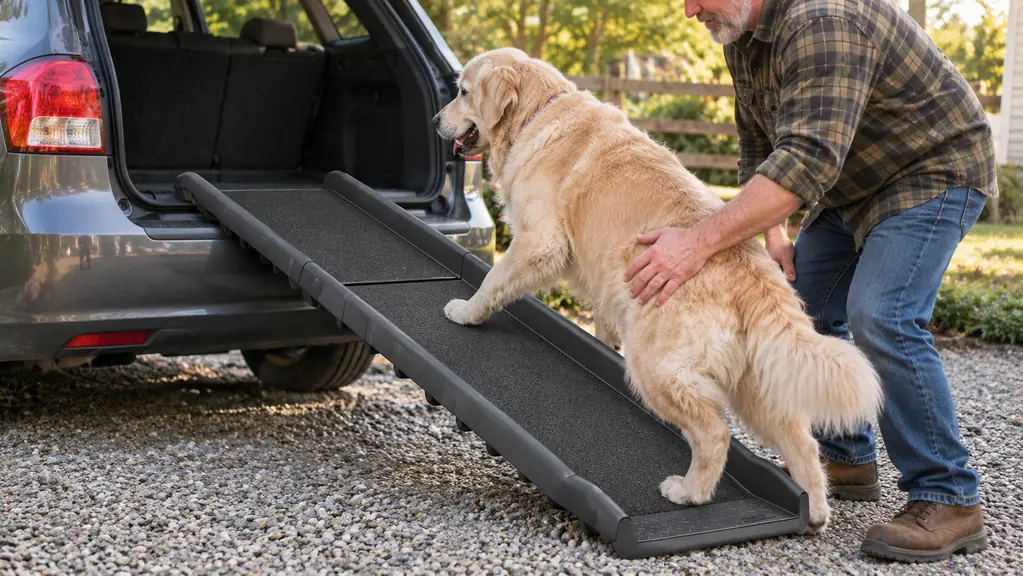
Ours lives in the garage, which tells you most of what you need to know. On a normal week I carry it out to the driveway, set the top edge on the Outback's cargo sill, and let Biscuit walk up while I keep a hand near his flank. He goes up. He rides. He comes down, and that last part is the one people underestimate. A stiff dog is often worse at stepping down than stepping up, because coming down is all braking, and a ramp helps in both directions.
I have also used it at the vet's parking lot, at a trailhead outside Black Mountain, and once at my sister's house to get him onto a porch. What I have not used it for is the staircase inside our house. Our stairs are carpeted and narrow and the ramp does not sit on them safely. That is not a knock on the ramp. It is the wrong tool for a staircase, and if that is your problem you want a different product entirely. We still take the indoor stairs together with me walking beside him and a hand on his harness, and on bad mornings he takes them one at a time.
The one place it did not work at all was our back deck. Three steps down to the yard, and the ramp is longer than the entire run of those steps, so it ends up lying at an angle so shallow it does nothing. I tried it twice and gave up. For the deck we use a harness with a handle and I take his back end on the bottom step. That is honest reporting, not a selling point.
What the Numbers Actually Mean
The listing gives the dimensions as sixty-two inches long, sixteen inches wide, and four inches, and the item weight as ten pounds. The load capacity is one hundred and fifty pounds. Biscuit is sixty-eight pounds, so we are working with less than half of what it will hold, which is the kind of margin I like in anything my dog stands on.
Ten pounds sounds light and it is. I am sixty-four and I have a right shoulder that complains about too much, and I can pull this out of the garage with one hand and set it in place without putting it down in between. That matters more than any other single number on the box. If a ramp is annoying to deploy, you stop deploying it, and then you are right back to lifting a sixty-eight pound dog into a station wagon.
Sixty-two inches matters for a different reason. The Outback's cargo floor sits a hair over two feet off the driveway. A short ramp at that height is a steep little cliff, and a steep little cliff is exactly what a stiff-hipped dog refuses. Sixty-two inches spreads that height out over a longer run, and the longer run is the whole trick.
The Angle Is the Whole Thing
When people ask me about ramps, the conversation always starts with brand and it always should start with length. A dog with arthritis in both hips is not evaluating tread patterns. He is evaluating whether the thing in front of him looks like a climb or a wall. Our first attempt at this was a set of folding plastic steps a neighbor lent us. Four steps, each one a jump of about eight inches. Biscuit looked at it once and walked back toward the house.
The PetSafe ramp changed the shape of the problem. Instead of four jumps it is one long slope. He puts his front feet on it, gets his weight forward, and the rest follows. Coming down is the same slope in reverse, and that is where I have seen the biggest change in him. For two years he would stand at the open tailgate in the evening and wait to be lifted down. Now he walks down on his own and trots to the back door.
One warning about angle: you need room behind the car for the ramp to lie out. In a tight parking garage or a crowded trailhead lot, sixty-two inches means you are either backing into the space or asking somebody to move. I have done both.
What It's Like Day to Day
The walking surface is textured and the sides have low rails. Biscuit is not a dog who likes edges, and those rails give him something to feel along his right side as he goes. The traction treads have held up well in wet weather, including a muddy morning in October when I expected him to slip and he did not.
Four rubber feet sit under the bottom edge. On our gravel driveway they bite and the ramp stays put. On the smooth concrete of the garage floor it is a different story. Under a dog's weight the bottom edge can walk sideways an inch or two, and the first time it happened I put my hand out fast. It has never shifted badly enough for him to lose his footing, but I hold the bottom of the ramp with one hand now, every single time, and I would tell anyone else to do the same.
Cleaning is a hose and five minutes. Golden hair works its way into the texture the way it works into everything else in this house, and a stiff brush gets most of it out. The hinge is the one spot I check, since grit collects there. PetSafe lists a one year warranty on it and makes it in the United States, which I looked up after the fact because I had assumed otherwise.
Folding it is a two-second job. The safety release latch holds it shut when it is folded, so I can carry it by the middle with one hand and not worry about it opening up on my shin, which happened to me with a folding table once and left me wary of hinges in general.
The Parts I Don't Love
It is plastic and it flexes. With sixty-eight pounds in the middle there is a visible bow, maybe an inch, and it makes a small noise when he steps off the end. It has held for a year of near-daily use and it is rated for more than twice his weight, so I am not worried about it failing. But if you are the sort of person who wants equipment to feel like equipment, this will feel light and slightly hollow underfoot.
Storage is the other thing. Folded, it is still over five feet long. Ours leans against the garage wall behind the door and it is fine there, but it is not going in a trunk without the back seats down and it is not going on a closet shelf. If you park on the street in an apartment, think about where it lives before you order it, not after.
And the honest part about the first two weeks: he did not want to use it. He stood at the bottom and looked at me. I put a piece of cheese three inches up the ramp, then six. We did four short sessions across a week and I ended every one before he got frustrated. If your dog is nervous, budget for that. A ramp does not train the dog. You train the dog.
What I Liked
- Ten pounds and one hand, so I actually use it instead of avoiding it
- Sixty-two inches makes a gentle angle at station wagon tailgate height
- One hundred and fifty pound rating leaves a big margin for a sixty-eight pound dog
- Side rails and textured treads hold up in wet weather
- Safety release latch keeps it folded while I carry it
Where It Falls Short
- The bottom edge slides on smooth concrete, so I hold it every time
- Visible flex in the middle under a large dog
- Folded, it is still more than five feet long and needs real storage space
- The first week of training is on you, not the product
The first week I coaxed him up with a piece of cheese. By the second week he was standing at the bottom of the ramp waiting for me to set it down.
What We Tried Before This
Before the ramp we tried lifting. I did it for the better part of a year and it is why my right shoulder is the way it is. A sixty-eight pound dog is not a bag of groceries, and the twisting motion at the tailgate is a bad one for a woman in her sixties. If you are lifting your dog into a car right now, that is the argument for a ramp, and it has nothing to do with the dog.
We also tried a harness with a handle on the back. That is still in the car and I still use it, mostly for the deck steps and for steadying him at the vet. It is a good tool. It is not a substitute for a ramp, because it does nothing about the height. The other thing that helped was getting weight off him. Our vet put him on a leaner ration two years ago and he is down a few pounds, and a leaner dog is easier on his own hips going up a slope.
What I did not try is a hydraulic lift, a belly sling, or a step stool. A sling is what our vet recommends for a dog who genuinely cannot bear weight, and if that is where you are, skip the ramp entirely and have that conversation first.
Who This Is For
This is for the owner of a big dog who still walks, still bears weight, and has started to hesitate at the back of the car. That is Biscuit exactly. Mild to moderate stiffness, some thinking at height, a dog who can do the climb if the climb is made easier. It is also for the person doing the lifting, which in our house is me, and I am not built for it.
It suits SUVs, vans, and station wagons with a load floor around two feet off the ground, which is where a sixty-two inch ramp makes the most sense. And it suits anyone with a garage wall or a corner to lean it against.
Who Should Skip It
Skip it if your dog cannot bear weight on a hind leg, has a spinal issue, or has started falling. That is a different problem and it needs your vet, a sling, and probably a mobility harness, not a slope. Skip it if your car is a sedan with a high sill and a short door opening, because the ramp will not sit well on it and you will fight it every time. Skip it if you drive a small car with no storage, because a five-foot folded ramp is a real object in your life.
And skip it if your dog is already managing the jump fine. Biscuit needed this at eleven, not at eight. A ramp for a dog who does not need one is just a thing taking up space in the garage.
If he still climbs but the climb has gotten hard, this is the fix
Ten pounds, sixty-two inches, rated to a hundred and fifty. It will not treat arthritis. It will get him into the car without you lifting him. Check today's price on Amazon.
Amazon Check Today's Price on Amazon →