
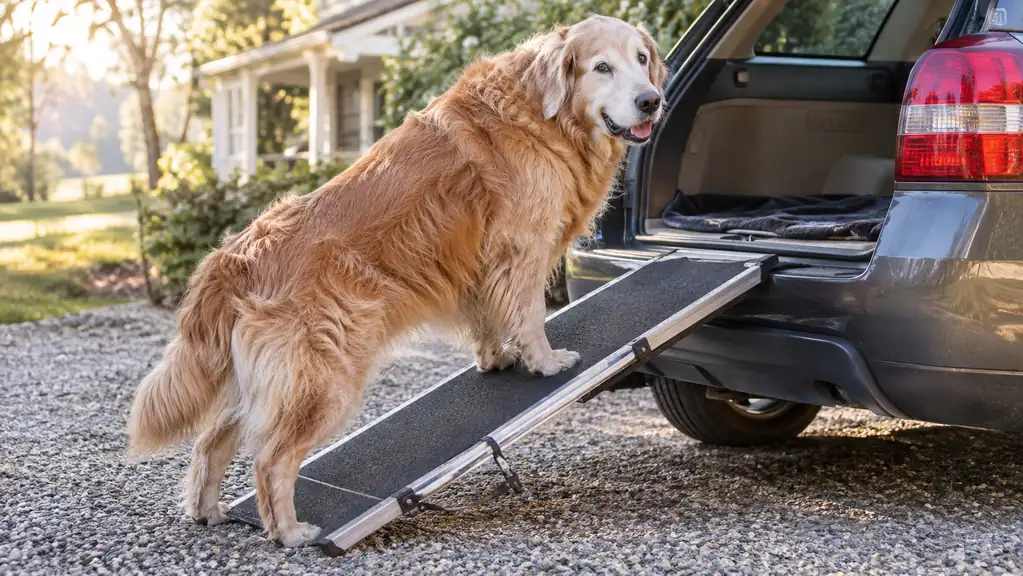
Biscuit is twelve years old, sixty-eight pounds, and stiff in the back hips until about ten in the morning. For two years I lifted his back end into the Subaru Outback, which worked fine until the morning my own back disagreed with the plan. That week I borrowed a set of carpeted pet stairs from a neighbor and I bought the PetSafe Happy Ride Folding Dog Ramp, and both of them lived in my garage for six weeks while I made up my mind. This is not a laboratory test. It is one old golden retriever, one driveway in Asheville, and a woman who got tired of doing the lifting.
Here is the short answer before the long one. If your dog needs help getting into a vehicle, the PetSafe Happy Ride Ramp is the better tool and it is not close. It is 62 inches long, rated to 150 pounds, weighs 10 pounds, and folds in half so it slides behind the back seat. If your dog needs help getting onto the couch, the bed, or the deck, pet stairs are the better tool, because a ramp aimed at a sofa is a trip hazard and a nuisance to store. Most of the confusion I see comes from people buying one of these for the other job. I nearly did.
One thing before the details. Biscuit was diagnosed with mild hip arthritis at his ten-year checkup, and our vet has been plain with me that no ramp, no set of stairs, and no supplement is treating anything. What these things do is make the day easier. That is a smaller promise than the packaging makes, and it is the only one I can stand behind.
| PetSafe Happy Ride Ramp | Pet Gear pet stairs | |
|---|---|---|
| Portability | Folds in half, 10 pounds, one hand to carry | One piece, takes both hands and a free hip |
| Storage | Folds to 4 inches tall, fits behind the back seat | Stays where you put it, or takes a shelf in the garage |
| Reach | 62 inches of run gets a big dog to a full-height tailgate | Four steps reach a couch, a bed, or a low car door |
| Floor space while in use | 62 inches of clear driveway behind the car | About two feet of floor |
| How the dog moves | A slope, which is a new skill to learn | Steps, the same motion as the staircase at home |
| Underfoot grip | High-traction plastic treads | Carpet, which gave my dog more to dig into |
| Load rating | 150 pounds, printed on the listing | Often not printed on the box at all |
| Side rails | Low rails on both sides | Open sides on most sets |
| Best for | Large dogs and tall vehicles | Couches, beds, and small dogs |
Where the PetSafe Happy Ride Ramp Wins
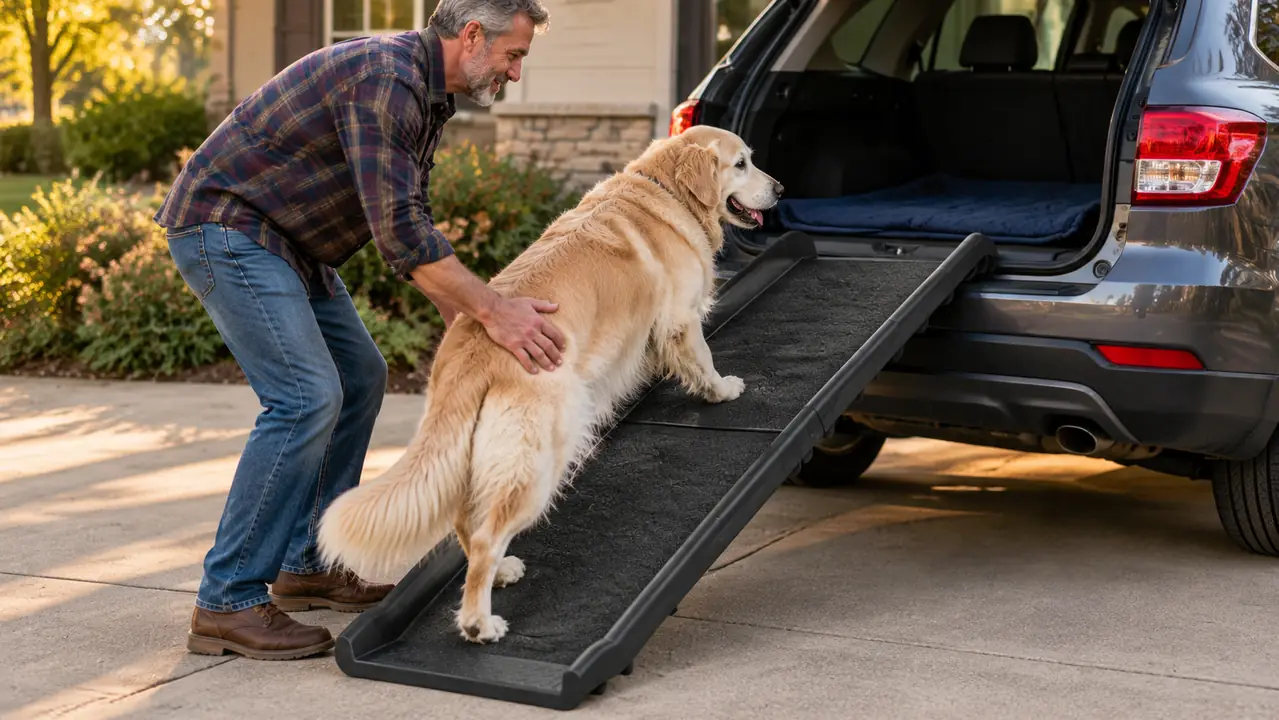
The number that sold me is ten pounds. I can carry it out of the garage with one hand and set it against the Outback's bumper without putting my keys down. It folds in half, and folded it stands 4 inches tall, which means it slides behind the back seat and stays there. A set of stairs does not do that. The stairs I borrowed lived in the garage, because they were too bulky to leave in the car and too annoying to drag out for every errand. If the tool is not in the car when the dog needs it, the tool does not exist.
Before the ramp I tried a plastic step stool I already owned, the kind that lives under the kitchen sink. It was a mistake. Biscuit put one front paw on it, felt it slide on the concrete, and backed away from the car entirely for four days. That is the thing about a sore dog: a wobbly surface teaches him that the car is not safe, and you pay for that lesson in patience. The PetSafe ramp does not shift when it is set down square. I can lean my weight on the tail of it with one foot and it stays put, and that steadiness is most of why he trusts it now.
The PetSafe ramp is rated to 150 pounds, which is more than twice Biscuit's weight, and it has low side rails on both sides that gave him something to feel with his shoulder on the way up. The treads are the high-traction kind, and four rubber feet keep it from walking away from the bumper on the driveway. It is 62 inches long, so it reaches a full-height SUV or truck tailgate without turning into a cliff. That length is the whole point. A short ramp on a tall vehicle is a steep ramp, and a steep ramp is harder on the hips than the jump it was supposed to replace.
It is also made in the United States and carries a one-year manufacturer warranty, which I mention only because the hinge and the safety release latch are the two parts that take a beating, and I like knowing a company stands behind them. The plastic wipes clean with a hose, which matters more than I expected in a North Carolina spring.
Where Dog Stairs Win
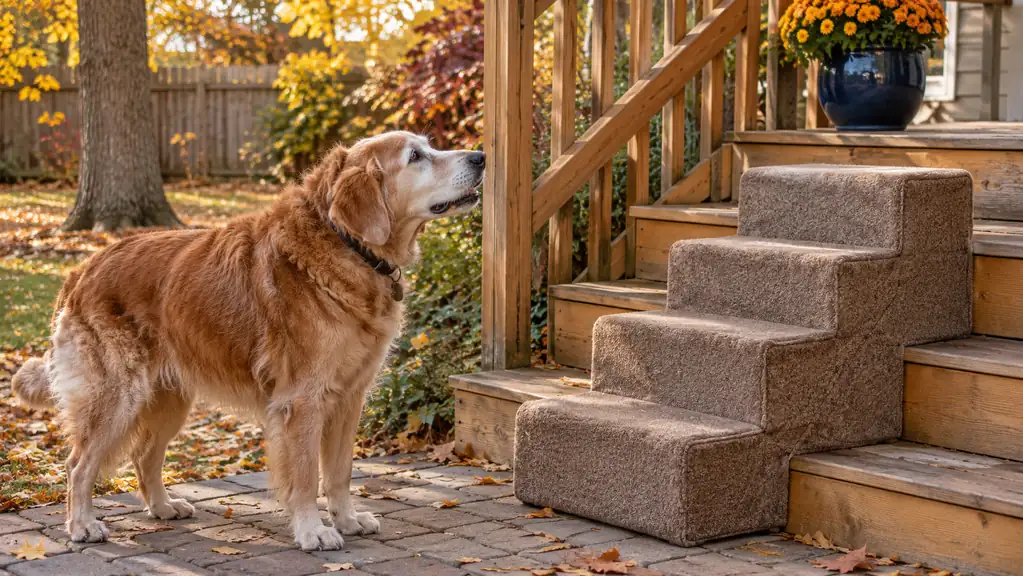
The stairs win on the thing I did not see coming: Biscuit already knows how to walk up stairs. He has done it ten times a day for twelve years on the carpeted staircase in our house. The first time I set the neighbor's four steps against the couch he climbed them without a pause, no treats, no coaxing. The ramp took three days of hot dog pieces and patience before he would put his front feet on it. For a dog who is nervous or already sore, the familiar motion is worth more than the engineering.
Stairs are also smaller. They take up about two feet of floor and they do not need a runway. The ramp wants 62 inches of clear space behind the car, and in a crowded driveway or a tight parking lot that space is not always there. And I will be honest about the grip: the steps I borrowed had carpeted treads, and Biscuit dug into that carpet with his nails in a way he never quite did on the plastic treads of the ramp. Next to a hardwood floor and a sofa, carpet wins, and it is not a close call.
Here is the exact afternoon it won me over. A rainy Sunday in April, no walk, a restless dog, and nothing to do. I set the borrowed stairs against the couch, and Biscuit went up on the first try, turned around at the top, and lay down with his chin on the cushion. No treats, no coaxing, no hand on the shoulder. He has climbed the thirteen carpeted steps in our front hall every day since he was a puppy, so the motion is already in his body. The ramp asked him to learn something. The stairs asked him to do something he already knew, and he did it in four seconds.
Ten pounds of folding plastic did what two years of me lifting did not. Most mornings now, Biscuit walks into the Outback on his own.
If the car is the problem, this is the one I kept
The PetSafe Happy Ride Ramp is 62 inches long, holds up to 150 pounds, weighs 10 pounds, and folds behind the seat so it is actually there on the day you need it.
Amazon Check Today's Price on Amazon →The Part Nobody Warns You About: The Angle
A ramp only works if the dog will use it, and the dog will only use it if the approach is calm. I had been setting ours down at a slight angle to the bumper, and Biscuit kept stepping off the side halfway up. Our vet's office gave me the practical version of the fix: set it square to the bumper, on flat ground, with all four rubber feet planted, let him sniff the whole length before you ask him to do anything, then guide him up with a hand at the shoulder rather than a hand at the collar. That fixed about eighty percent of it in one afternoon.
Our tailgate sits at 27 inches off the ground. Run 62 inches of ramp up to 27 inches and the slope is gentle enough that I would push a wheelbarrow up it. Set the same ramp against a lifted truck and it turns into a climb. That is the whole arithmetic of these things, and it is why I measured before I bought rather than after. Coming down was the harder half for Biscuit. Going up he can drive with his back legs. Coming down he wanted to bunny-hop the last foot, so I walk beside him with a hand hovering at his shoulder and let him set the pace. Two weeks in, he took it slow and even, and that was the day I stopped worrying about it.
The other thing nobody mentions is that a ramp is only as good as the space you can give it. On a flat patch of driveway it lays down at a gentle angle and Biscuit walks it like a sidewalk. In a cramped lot at the grocery store, the same ramp is suddenly steep, and steep is exactly what we were trying to avoid. So the ramp travels in the car and comes out when there is room, and on the tight days I park at the far end and we take the long walk. That is a real cost, and it never shows up in the listing photos.
How I'd Decide, Faster Than I Did
Ask what the dog cannot do. If the answer is the car, get the ramp. If the answer is the couch, get the stairs. If the answer is both, and with a twelve-year-old retriever it will be both eventually, buy the ramp first, because the car is the higher step and the harder lift on your own back.
Then measure, with a tape, before you buy anything. Measure the height of your tailgate and the clear space behind it. A 62-inch ramp on a low tailgate is a lazy slope and easy for a stiff dog. The same ramp on a lifted truck is a climb. Stairs run the other way: they are fine up to about knee height and close to useless above it. I measured our couch and our back deck steps before I spent anything, and it saved me from buying the wrong second thing.
The Two Things Neither One Fixes
Neither product fixes the morning. Biscuit is still slow off his bed at seven o'clock whether the ramp is in the car or not, and the three steps down to the back deck are still a negotiation. What the ramp changed was the car, and the car was the part that had me lifting sixty-eight pounds twice a day. If your dog is stiff on the staircase inside the house, a ramp in the driveway will not touch that. We put a long runner rug at the bottom of our stairs instead, and that did more for him than either product did.
The runner rug is worth describing because it was already in the house and did more than either product. It is a 12-foot carpet runner that used to live in the upstairs hall, and I put it at the bottom of the front staircase where the hardwood meets the first step. Biscuit had been skidding on that turn for a year and I had not really seen it until our vet watched him walk. His nails were long, too. We had them trimmed in February and the difference in how he took the stairs was obvious within a week. Neither the ramp nor the stairs gets credit for any of that, and I would be lying if I said they did.
The other thing is weight. Our vet was direct about it: a twelve-year-old retriever carrying extra pounds is a harder load on arthritic hips. Biscuit was two pounds over where she wanted him in January, so we cut back the between-meal biscuits and switched to green beans for the begging, and by spring he was back where she wanted him. The ramp and the stairs help him get where he is going. They do not change what is happening in the joint, and anyone who tells you otherwise is selling something.
Who Should Buy Which
Buy the PetSafe ramp if you have a big dog, a tall vehicle, and a back that has already filed a complaint. Buy it if your dog is over fifty pounds, because lifting fifty pounds of reluctant dog is a two-person job and you will not always have the second person standing there. I would buy it again tomorrow, and I say that as someone who spent three days convincing a golden retriever that a piece of plastic was not a trap.
Buy the stairs if the problem is the couch, the bed, or three steps down to the deck, and if your dog is small enough that a tumble off the sofa is the risk you are managing. Buy the stairs if your dog is nervous about new surfaces, because steps are the surface he already knows. And if your dog is small and only needs the couch, stairs are the simpler buy and there is no reason to overthink it.
The one that stayed in my car
Six weeks, both of them in the garage, one clear winner for the vehicle. The PetSafe Happy Ride Ramp folds to 4 inches, weighs 10 pounds, and holds up to 150 pounds, which is plenty for a stiff twelve-year-old golden and his tired owner.
Amazon See the PetSafe Ramp on Amazon →