
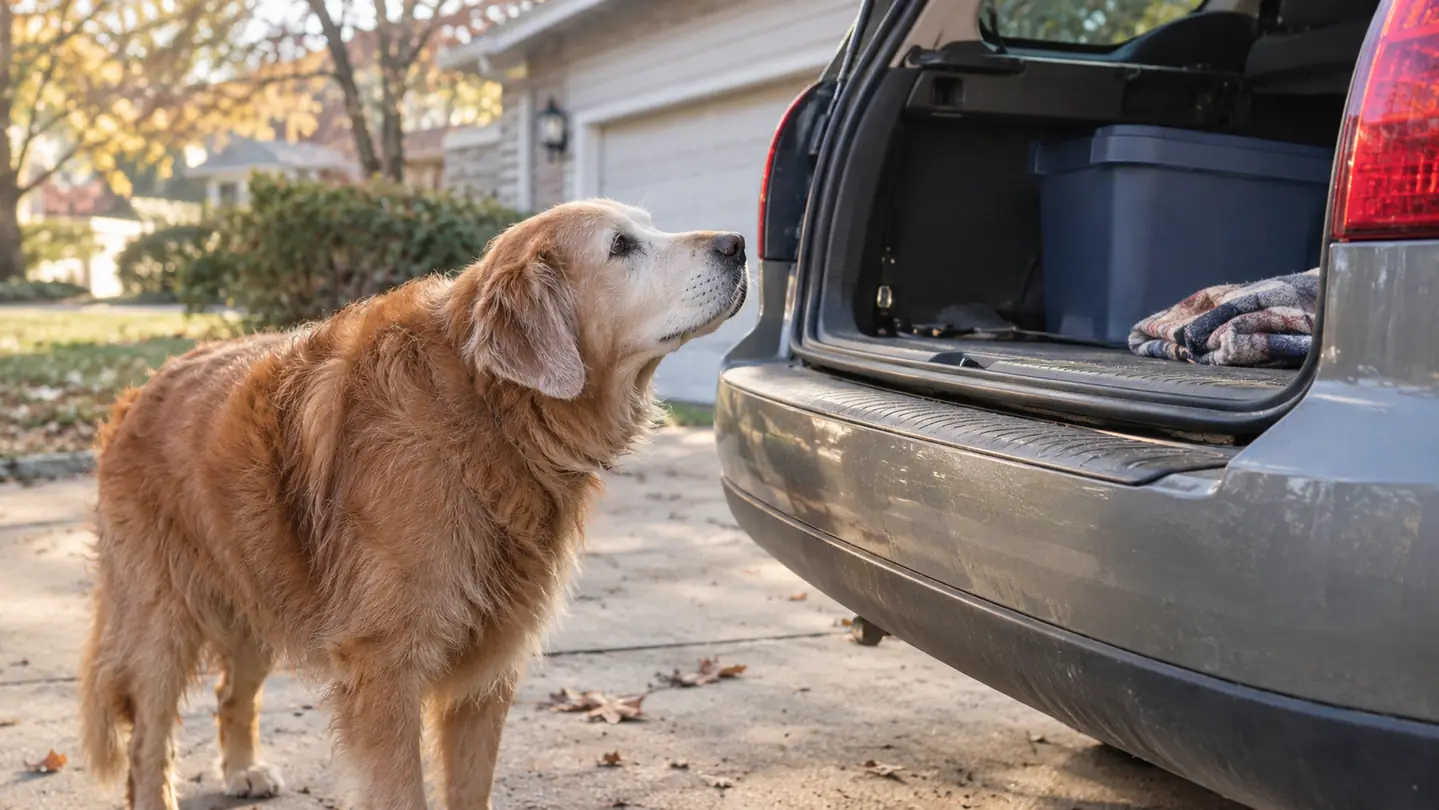
Biscuit is twelve years old, sixty-eight pounds, and a Golden Retriever, so for most of his life the back of our Outback was not something he had to think about. He just got in. Around his tenth birthday he started stopping at the bumper with all four feet still on the ground, and looking at me. Not scared. Thinking. Then he would walk around to the passenger door and wait, as if a different door might open lower.
I tried two things that did not work before I tried a ramp. Lifting him seemed kind and was not: a sixty-eight pound dog hoisted under the ribs slides, scrambles, and lands hard, and my own back is sixty-four years old. A set of steps borrowed from a neighbor was better, but he only tolerated them, and on a wet morning one of them shifted under his back foot. What changed things was the PetSafe Happy Ride Folding Dog Ramp. Our vet diagnosed mild hip arthritis when Biscuit was ten. I am not a vet and this is not treatment advice. It is logistics: how we get a stiff, heavy, proud dog into a car twice a day without either of us getting hurt.
The part of Biscuit's day that hurt most was a two-foot step into the back of a car
The Happy Ride is a two-panel folding ramp, 10 pounds, rated to 150 pounds. Sizing matters more than anything else on this page, so measure your cargo floor height first, then check today's price.
Amazon See Today's Price on Amazon →Step 1: Measure the bumper height and the door opening, not the dog
Before I bought anything I put a tape measure on the ground and ran it up to the cargo floor of the Outback. Just under two feet. Then I measured the opening at its narrowest point, between the weather stripping, because a ramp that is too wide will not sit in the door well no matter how good it is. The PetSafe Happy Ride is 62 inches long and 16 inches wide. It lists a load capacity of 150 pounds, which is more than double Biscuit at 68.
Height is the number that decides everything, because height is what sets the angle. A 62 inch ramp leaned against a two foot lip puts the deck at roughly 22 degrees, which is a walkable grade for a stiff dog. That same ramp against a taller tailgate is suddenly much steeper, and steep is the exact thing you are trying to fix. If your vehicle's floor sits much higher than two feet, measure before you order and think about a longer ramp.
The other number is weight, and this one is about you. The ramp is 10 pounds and folds in half. I carry it out of the garage one-handed. My neighbor's wooden ramp weighed closer to thirty and lived against the wall because neither of us wanted to move it. A ramp you do not want to carry is a ramp that stays in the garage, and this whole plan depends on the ramp being there.
One more measurement people skip: the dog, not just the car. Biscuit is tall enough that his back sits above the wheel arch, and when he stands at the bottom of the ramp his nose is already level with the cargo floor. A smaller dog covers a 62 inch deck in three strides and has time to think about it. A big dog covers it in two and does not. That is not a reason to skip the ramp, it is a reason to walk beside him the first ten times instead of standing back and watching.
Step 2: Leave it flat on the floor for a week before you ever raise it
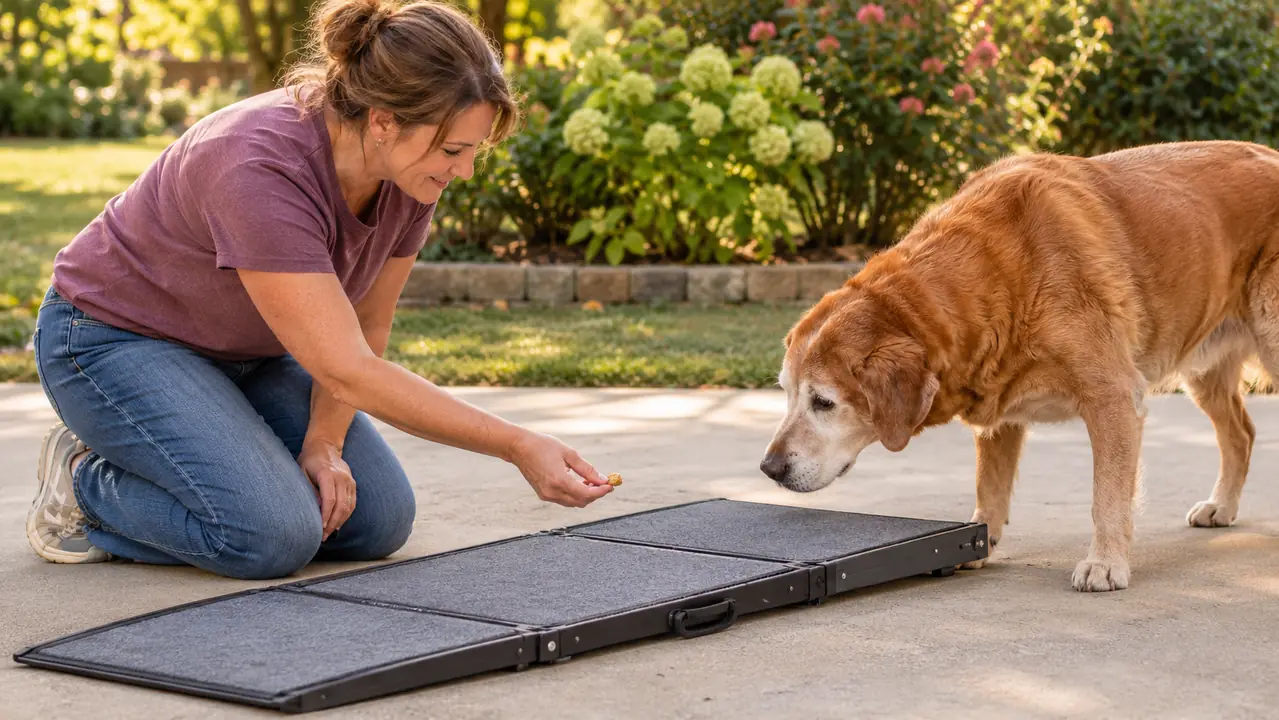
Dogs do not generalize the way we do. A folded ramp leaning in the garage is a strange object, and a strange object that clatters when it unfolds is worse. So for the first week the PetSafe ramp lived flat on the kitchen floor. Not propped against the counter, not half open. Flat, and in the way, which was the point.
I scattered kibble along the treads twice a day and said nothing. The first two days he ate the kibble off the floor at each end and stepped over the middle. On day three he put a front paw on it. On day five he walked the length of it for a piece of chicken. Biscuit has spent twelve years on hardwood floors and walks them like a cat, picking his pads up high, so a textured surface reads to him as safer ground, but only once he has decided it will not move.
One caution about the kibble. I feed two meals a day and I used part of his dinner for this, not extra food on top, because a dog who gains weight over a ramp-training week has badly missed the point. If food does not motivate your dog, a favorite toy dragged slowly along the deck works the same way.
That is the whole test. If your dog will not cross the ramp lying flat on the floor, he is not going to walk up it at bumper height, and forcing the issue buys you a dog who avoids the driveway for a month. Give it the week.
Step 3: Set it up the same way, in the same spot, every single time
Ramps fail at the bottom, not the top. The four rubber feet need something that does not give: pavement, concrete, a rubber mat on a garage floor. Gravel, wet grass, and a sloped driveway all let a foot creep, and a foot that creeps becomes a ramp that shifts under a back leg. One shift is all it takes. After that you have a dog who will not go near the thing, and you have lost a month.
Ours has a safety release latch, and my rule is simple. The ramp is fully open, both panels flat, and the top edge resting on the cargo floor before any dog is on it. I press down on the deck with the flat of my hand first, then go and get him. It takes about four seconds and it has caught a bad setup twice.
Same place in the driveway, hatch all the way up, ramp set first, dog second. Biscuit knows the order now and he starts toward the car when he sees me lift the ramp out. Dogs are better at routine than we are, and routine is what turns a strange object into a normal part of leaving the house.
If your only parking spot is gravel, a rubber mat under the feet helps more than you would think, and a piece of plywood under the mat helps more than that. It is not elegant. It is also the difference between a dog who loads and a dog who refuses, and both pieces live in the car with the ramp.
Step 4: Walk beside him, keep your hand on the harness, and do not push
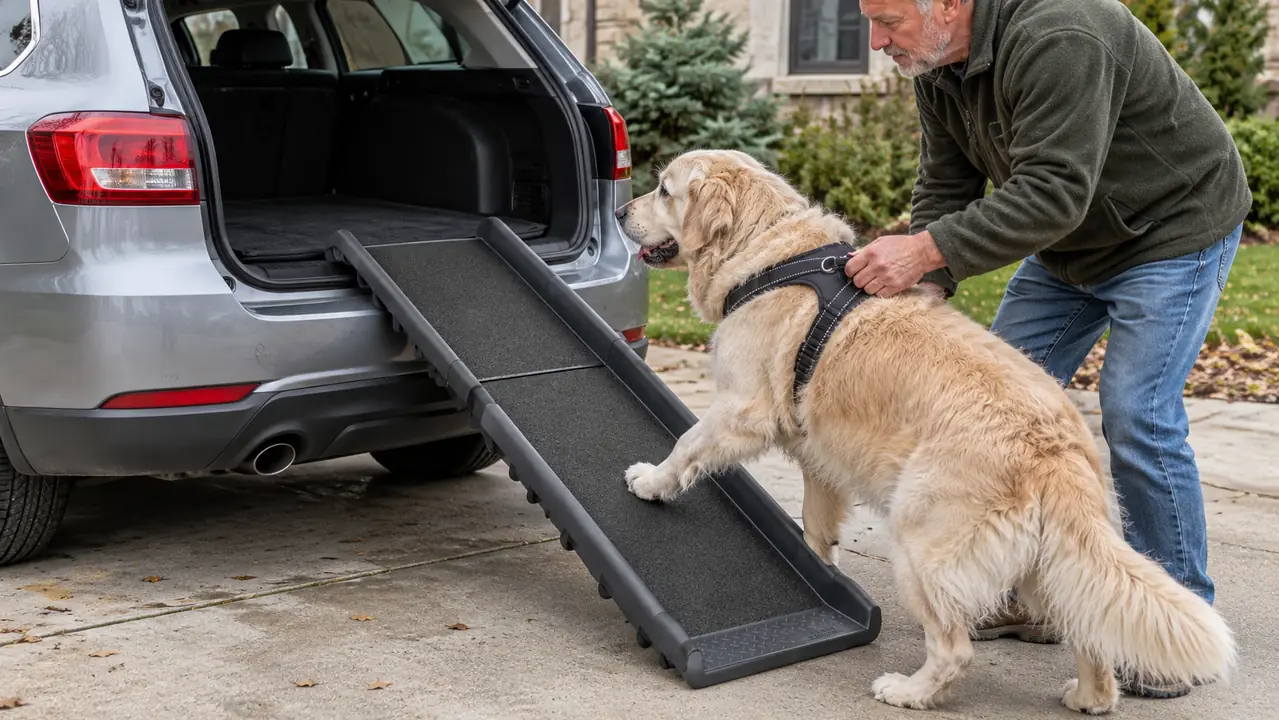
Our vet gave me one firm instruction about this, and it was not to push up on the back end. A dog pushed at the hips twists and fights it, and the push does nothing for the joint anyway. A hand under the belly is a different thing, and on a 68 pound dog it is also a two-person job. What works is a harness with a handle over the shoulders, my hand on that handle, and letting him set the pace.
The treat is a target, not a bribe. I hold it at nose height, a foot in front of his face, so his head stays level and his feet follow his nose up the deck. If I hold it high he lifts his head and shortens his stride, and a short stride on a ramp is how a back foot catches the side rail. Level nose, steady pace, no rush.
For the first week Tom stood at the bottom with the toe of his boot against the rubber feet while I walked up beside Biscuit. He was up in about eight seconds. It took me three times that long to stop holding my breath.
The other thing that helped was making the trip worth it. I do not load him to go to the vet. I load him to go to the greenway, where he can walk on grass at his own pace for twenty minutes. By the third week he was waiting at the bumper in the morning, which is a thing I did not expect to see again.
Step 5: Practice the way down, then keep the ramp in the car
Coming down is where the trouble is. Dogs come down faster than they went up, they look at the ground instead of the deck, and a back foot slides off the edge. I lead him down, hand on the harness, walking beside the ramp rather than standing at the bottom and calling him. Calling him makes him hurry, and hurrying is the whole problem.
The ramp folds to about four inches thick, so after the second week I stopped taking it out of the car at all. A folded PetSafe ramp rides in the back of the Outback now, every day. That matters more than it sounds. Two minutes of setup is the difference between using the ramp and deciding to just lift him this once, and the mornings his hips are worst are exactly the mornings I would take the shortcut.
One practical note on storing it. A folded ramp in an open cargo area slides. I keep mine against the back of the second row seats, latch side up, so it does not become a missile when I brake. That takes about five seconds and it is the only part of this routine I would call non-negotiable.
On wet days I wipe the treads with a towel before he loads. It takes ten seconds and it is the only maintenance the thing has needed in a year and a half, apart from rinsing the mud off the rubber feet.
A ramp does not treat arthritis. What it did was take one two-foot drop out of Biscuit's day, and that turned out to be the one he was dreading.
What Else Helps
Some of this is not about the ramp at all. Nails matter: a dog whose nails are too long cannot get traction on anything, and our groomer took Biscuit's back nails shorter than usual and it showed on the treads the same week. Weight matters more. Our vet wanted two pounds off him and we got them, mostly by measuring his food instead of eyeballing the scoop, and two pounds off a dog with hip arthritis is not nothing.
Where you park helps too. A sloped lot can be turned into a flat load by parking nose downhill, or by finding the one spot near a curb where the ground already meets the bumper higher. A mat at the bottom of the ramp on wet pavement is worth carrying. And it is worth saying plainly: a ramp makes a hard thing easier, it does not fix a joint. If your dog is limping, or has stopped getting up after naps, that is a vet conversation, not a shopping decision.
I did try the alternatives honestly. Steps are fine for some dogs and I know people who swear by them, but Biscuit would take one and stop, and a stopped dog halfway up a set of steps is worse than a dog still on the ground. Lifting him works until it does not, for his back or for mine. The PetSafe Happy Ride only won because it is one continuous surface, and because he can see the whole path at once.
He still gets in the car. That is what the ramp bought us.
The PetSafe Happy Ride has been folded in the back of our Outback for a year and a half, through two winters and one very muddy spring. Two panels, 10 pounds, 150 pound capacity. If your dog is hesitating at the bumper, start with the tape measure, then check today's price.
Amazon See Today's Price on Amazon →