
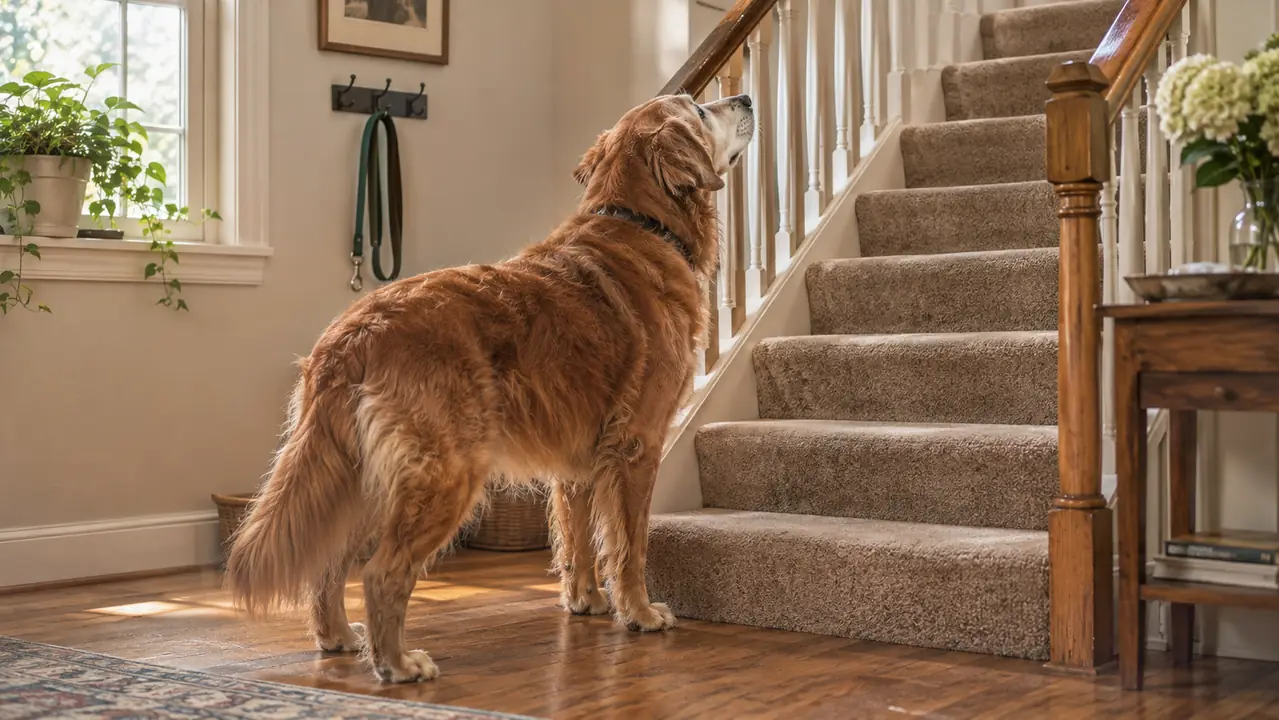
Our staircase has thirteen steps, and for eleven years Biscuit went up and down them like they were nothing at all. He is a Golden Retriever, twelve now, about sixty-eight pounds, and somewhere around his tenth birthday he started stopping at the bottom and looking up at the landing like it had moved farther away. Our vet found mild arthritis in his hips at that checkup. Not an emergency. Just a fact we had to start planning around.
I tried the cheap fixes first. A runner rug so his feet would stop sliding on the hardwood. A ramp for the back of the Subaru Outback, which he tolerated and I did not, because it is long and heavy and I am sixty-four. I tried carrying him, which lasted exactly one trip and was bad for my back and worse for his dignity. What actually worked was a LOOBANI lift harness, a nylon sling that goes under his hindquarters so I can take some of his weight while he does the climbing. This is how we use it, step by step, including the parts nobody tells you.
The thing that ended the standoff at the bottom of our stairs
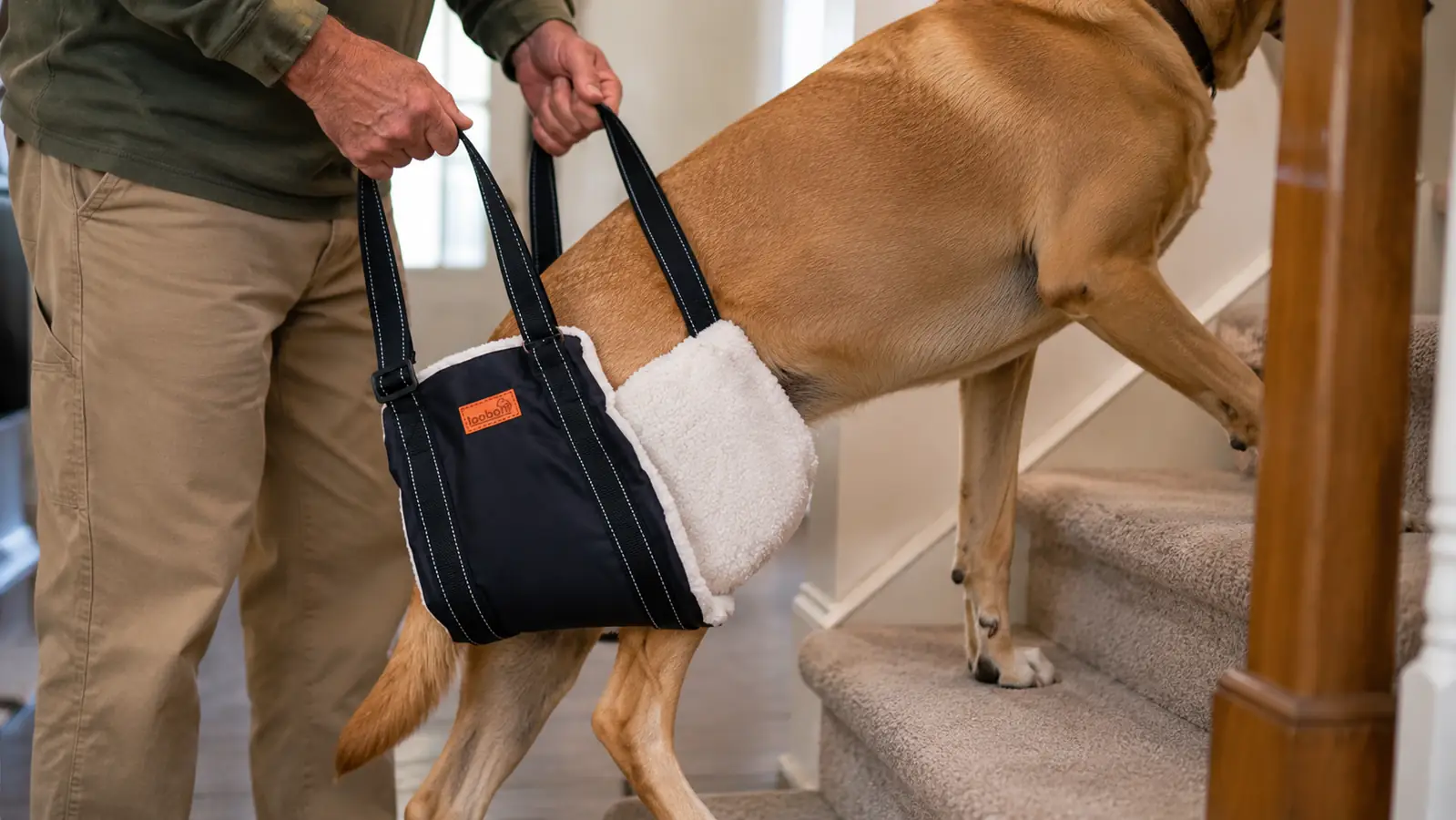
A padded nylon sling that tucks under the hindquarters so you can take part of the weight while your dog does the climbing. X-Large sizing for large dogs, a soft fleece-like lining, machine washable, and it folds into the storage bag it comes with.
Amazon Check Today's Price on Amazon →Step 1: Measure Before You Order, Not After
The most common mistake people make with a lift harness is ordering by the weight on the bag and nothing else. Weight gets you in the neighborhood. Measurement gets you the right fit. I stood Biscuit on the rug in the living room, ran a soft tape around the widest part of his hindquarters just in front of the back legs, and wrote the number on the back of an envelope. Then I checked it against the size chart instead of guessing. The one we use is X-Large, sized for large dogs, and at sixty-eight pounds he sits comfortably in the middle of it rather than out at the edge, which is exactly where you want to be.
Two other numbers matter less than people think. The sling itself weighs just under fifteen ounces, so it is not something he notices hanging on him, and it folds small enough to live in the storage bag that comes in the box. Ours sits on the fourth step when it is not on him, because that is the spot I will actually reach for. If yours ends up in a closet behind the vacuum, you will not use it, and an unused harness helps nobody, least of all the dog.
While you are still inside the return window, look the stitching over and check the lining. Ours is nylon with a soft, fleece-like lining along the part that touches him, and after two winters of Asheville damp it has held up fine. It is machine washable, which sounds like a small feature until the first muddy January. Wash it on a dry day so it can hang on the porch rail and be back on the fourth step by evening.
Step 2: Fit It While He Is Standing Still
Fit it with all four feet on the floor and the dog standing square, not sitting. A sitting dog gives you a false reading, because everything shifts forward and the sling ends up somewhere it will not sit when he moves. I slide the sling under Biscuit from the side, work it forward until the padded section rests under his belly and just ahead of the back legs, then take up the slack.
The closure on ours is a drawstring, and the temptation is to cinch it down hard so nothing moves around. Do not. Snug is enough. If the lining is digging a crease into his flank, or the sling keeps riding forward toward his ribcage, it is too tight, and he will tell you by refusing to stand still the next time you bring it out. A dog who dreads the harness is a dog who fights the stairs.
Give him a minute to just stand there wearing it before you ask for anything at all. I hold the sling with a little slack and let Biscuit sniff the rug and think his thoughts. The first three times we did this he stepped out of it sideways and walked off. The fourth time he stood. That is the entire training program, repeated until standing still is boring, and boring is what you want.
Step 3: Practice on Flat Ground Before You Go Near the Stairs
Before the staircase, practice on flat ground. The hallway, the kitchen, the flat part of the back deck. I take up a small amount of weight, maybe a fifth of what he carries, and walk beside him at his own pace for four or five minutes. The point is not exercise. The point is teaching him that pressure under his belly means I am helping, not holding him back, and that takes repetition rather than explanation.
Watch his feet while you do it. On hardwood he will skitter, and skittering teaches him that the harness equals instability, which is the opposite of what you need. Put a runner down or practice on carpet. Our downstairs is hardwood and the staircase is carpeted, so we did the early sessions on the landing at the top, a small carpeted rectangle that is about as safe a place as this house offers.
Then the deck. Three steps down to the yard, low risers, grass at the bottom if anything goes wrong. We did that for a solid week before I pointed him at the real staircase. If your dog has a short flight anywhere, a single step up into the garage, a curb by the mailbox, start there. Confidence is built in small pieces and it does not transfer automatically from one set of stairs to another.
Step 4: Take the Staircase One Step at a Time
Going up, I stand beside him and one step below, on his left, every single time, so the routine is identical and he knows what is coming. The sling is under his hindquarters and I take up weight as he pushes off, then give it back as he lands. That rhythm matters more than the amount of help. If you hold a constant pull, he fights it the whole way up. If you take weight only on the push, he leans into the help instead of bracing against it.
Coming down is the direction that scares me, and it should scare you a little too. I stand beside him and one step ahead, which puts me below the back legs where the load actually is. He puts a front paw down, I take the hindquarters, he brings the back leg through. One step at a time, all thirteen of them. I do not let him set the pace on the way down. Slow is the entire point of the exercise.
Two rules I do not break. I never lift him, because lifting a sixty-eight pound dog by a sling is how a sixty-four year old woman ends up at the physio with her own problem. I take weight, he does the work. And I never rush a landing. At the top there is a small carpeted square where he stops, shakes out his back legs, and decides the trip was acceptable. Give your dog that pause. It costs eight seconds and it keeps the whole thing calm.
Step 5: Make It Routine, and Know When to Stop
Biscuit is stiffest in the morning and after a long nap, so the LOOBANI harness lives on the fourth step and goes on before he has a chance to think about whether today is a stair day. Same story with the Outback. The back of a Subaru is a jump he should not be doing alone anymore, and the sling works there too, one hand under the hindquarters while his front paws find the bumper.
Keep a note of it. I am not organized by nature, but I wrote down how many stairs he managed each week for the first two months, and that turned out to be the most useful thing I did all year. When the number started creeping down in November, I had something concrete to bring to our vet instead of a vague feeling that he seemed worse. A calendar on the fridge beat my memory without much of a contest.
And know the limits of the thing. A lift harness is a mobility aid. It is not treatment, it does not slow arthritis down, and it does not replace your veterinarian. If your dog yelps on a step, starts knuckling over on the back feet, drags a toe, or refuses the stairs entirely when he used to manage them, that is a phone call to the vet rather than a reason to buy a better sling. Ours has been very clear with me on that point and I will pass it straight along to you.
What Else Helps
The harness is one piece of the picture. The rest of the house has to cooperate with it. We put a runner at the bottom of the stairs because Biscuit was slipping on the turn, and that alone cut out roughly one stumble a week. I keep his nails short, because a long nail on a hardwood floor is a slip waiting to happen. And I watch his weight as carefully as the vet and I can manage, since every extra pound is a pound those hips have to carry up thirteen steps twice a day.
We also changed what we ask of him. The ramp stays in the Outback for the days his hips are bad. The morning walk happens after he has been up and moving around the house for twenty minutes, not the moment he rolls off his bed. He sleeps on a bed that sits off the floor, because getting up from a flat sprawl on cold boards was clearly harder than pushing up from something with an edge to lean on. None of it is dramatic. It is just the environment rearranged so that a stiff dog has fewer chances to fall.
Our vet has him on a joint supplement and rechecks him twice a year, and I want to be careful about what that does and does not mean. Supplements support joint health. They are not a treatment for arthritis, and they did not reverse anything in this house. The harness did not either. What the harness did was give him back a staircase he had quietly given up on, and that changed the shape of his day, because the bedroom is upstairs and he is a dog who wants to be where his people are.
The harness did not make the arthritis go away. It made thirteen steps possible again, and most days that is the same thing.
If your dog has started stopping at the bottom of the stairs
The LOOBANI lift harness is a padded nylon sling with a fleece-like lining that sits under the hindquarters. X-Large sizing for large dogs, machine washable, and it folds into the storage bag that comes with it. You take the weight, your dog does the climbing.
Amazon Check Today's Price on Amazon →