
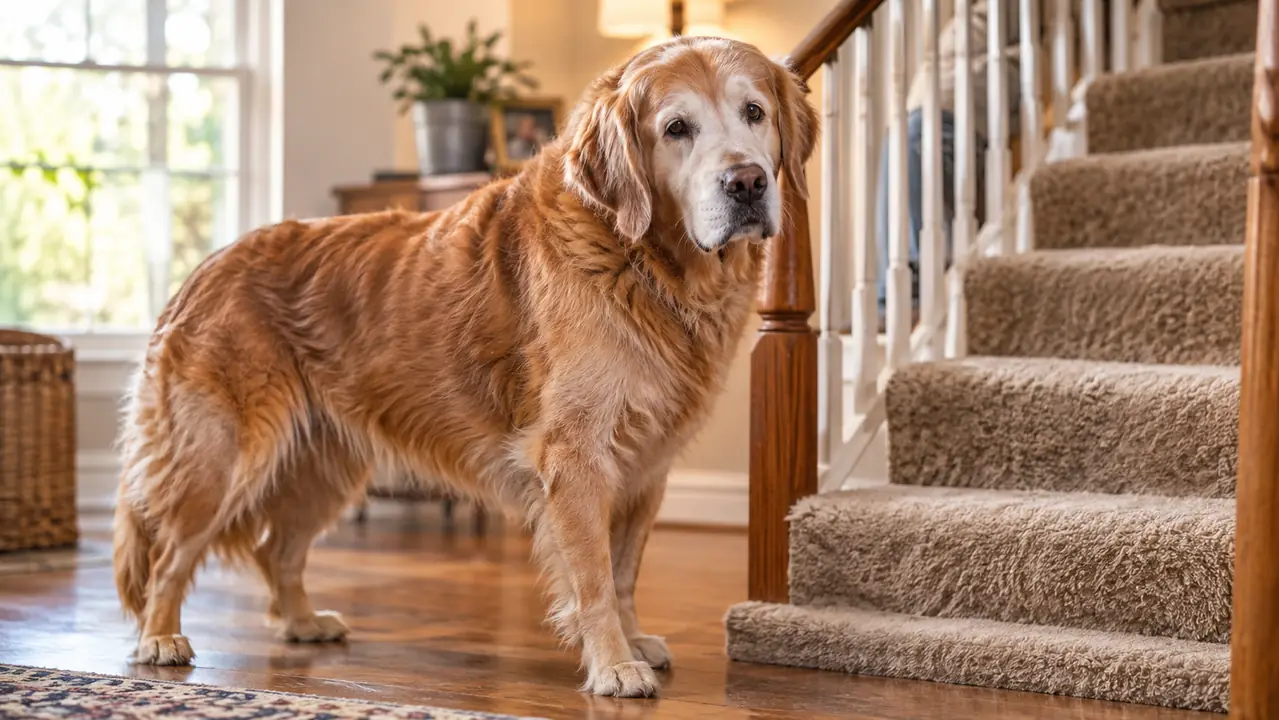
Biscuit turned twelve in March. The honest version of that sentence is that he turned twelve in March and quietly stopped doing the back stairs in April. He is a 68-pound Golden Retriever with mild hip arthritis that our vet diagnosed when he was ten, and on flat ground he still moves like a dog with somewhere to be. It is the three steps off our deck, the carpeted staircase in a two-story house, and the lip of the Subaru Outback tailgate that started costing him something.
I bought the LOOBANI lift sling on a Tuesday, in a bad mood, after standing in the yard watching him think about those three steps for a full minute before he took them. I had already tried what people suggest. I put a mat at the bottom of the stairs. I moved a bed to the living room. I measured for a ramp and decided our deck was too narrow to make one safe. What I wanted was something I could keep by the back door and pick up with one hand. That is close to what this sling is. It is also less than what the product photos imply, and the gap between those two things is what this review is about.
The Quick Verdict
A washable sling that genuinely takes weight off a stiff back end on stairs and car loading. It does not lift the dog for you, and your dog has to be willing to wear it. Worth the hook by the door.
Amazon Check Today's Price →For the dog who has started stopping at the bottom step
The LOOBANI sling weighs about fifteen ounces, folds into the storage bag that comes with it, and goes in the washing machine when it needs to. Ours hangs by the back door and has been in near-daily use since April.
Amazon Check Today's Price on Amazon →How I've Actually Used the LOOBANI Sling
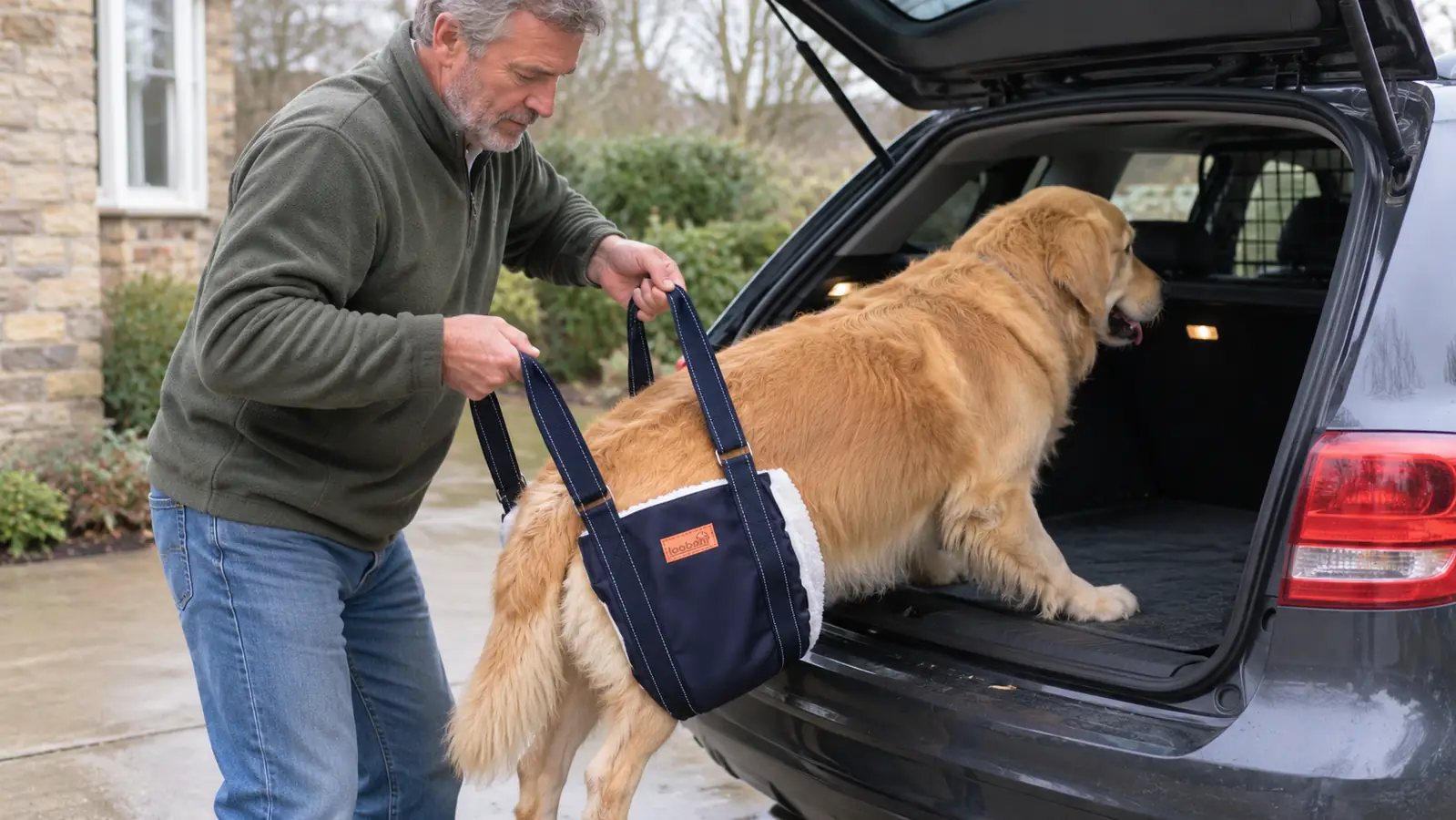
There are two ways we use it, and neither matches the picture I had in my head. The first is the staircase. I stand behind him and slightly to the side, pass the sling under him just forward of his back legs, snug the drawstring, and take a share of his weight while he climbs. Coming down I take more, because down is harder for him than up. The second is the car. At the Outback I set the sling, lift with my forearm rather than my lower back, and he steps onto the tailgate instead of scrambling at the bumper.
That is the whole job. It is not a walking harness and I have never used it on a walk. It is for the twenty seconds when his back end needs help and his front end is fine, which turns out to be the twenty seconds that decide whether he comes downstairs in the morning or stays up on the landing looking at me.
The first week was not good. He walked sideways with it on, then sat down in the middle of the staircase, which is its own kind of terrifying. What fixed it was shortening everything. Three steps, off, a piece of chicken. Three steps, off, chicken. By the end of the second week he was stepping into position himself when I lifted the sling off the hook, which is the most honest endorsement I can give a piece of equipment.
Tom uses it too, mostly for the car, because he does the Saturday errands. He is taller than I am and stands a little further back, and he says the sling is easier to hold than the towel we were using before, which kept slipping out of his hands. That towel is worth mentioning. We used it for a month and it was worse in every way.
One morning in June I timed it, because I am that person. From the hook by the door to the bottom of the staircase was forty seconds, counting the time it took to set the sling and get him squared up. The same trip in March, with me hovering and him hesitating and neither of us committing, ran closer to three minutes and ended with me carrying him the last four steps, which is not a thing a 64-year-old with a sore shoulder should be doing. Forty seconds against three minutes is the argument for the sling, and it is the version I give people when they ask me whether it is worth it.
What Nobody Tells You Before You Buy a Lift Sling
Here is the part the product photos leave out. The sling does not lift your dog. You lift your dog. The sling gives you somewhere to hold on, moves the strain from your fingers into your forearm and shoulder, and keeps you from grabbing a handful of skin at the hip. That is worth something, especially at 68 pounds. But if your back is bad, or if your dog is much heavier than mine, you are still the engine, and a second person on the stairs is safer than a sling alone.
Second thing. Your dog has to agree to it. Some dogs take to a sling in a day. Biscuit took about ten days and a lot of lunch meat. If your dog panics when something touches his back end, which is common in dogs whose hips hurt, work up to it slowly and let the first sessions be with the sling in the room instead of on the dog. Nobody at the company is going to tell you that, because it is not a selling point.
Third thing, and this is the one that surprised me. It is a transfer tool, not a mobility device. It helps him stand, helps him on the stairs, helps him in and out of the car and up onto the couch. It does not make a stiff dog walk further. I learned that in the first month, when I was using it to help him across the living room and he got no stronger for it. Our vet was plain about it. Let him do the work he can still do, and help only with the work he cannot.
The sling does not lift my dog. It moves the work from my lower back to my forearm, and that turned out to be the whole point.
The Fit Question, and Why the Drawstring Matters
Ours is the X-Large, the size for a large dog, and Biscuit at 68 pounds sits in it with room to snug down rather than room to slide around. The sizing question I could not answer from the listing was where the sling should sit. The answer after a few weeks is just forward of the back legs, under the belly, snug but not tight. If it slides forward toward the ribs, it is too loose and it will not do anything. If the drawstring is tight enough to leave a mark, it is too tight.
I measured him with a cloth tape before ordering, around the widest part of his hindquarters just in front of the back legs, and got 27 inches. The X-Large had room to take that up. If I had ordered on weight alone I would have landed in the same place, but the tape is what told me the sling would sit where it needed to and not creep up toward his ribs halfway through a staircase.
The drawstring is the part I use most and the part I did not expect. It is how you get the sling to stay where you put it while your dog is moving, and it is how one sling covers a range of dogs rather than one exact shape. The closure is simple enough that I can set it with cold hands on a winter morning, which matters more than it sounds.
The lining is soft, with a sheepskin-like texture and a thickened layer beneath it, and after four months of daily use on a dog who sheds constantly it has not rubbed him anywhere. The outer material is nylon, and it is machine washable. I wash ours every other week on a normal cycle and let it air dry over the porch rail.
It weighs 14.88 ounces. That sounds like a meaningless spec until you have carried a wet, heavy harness back and forth from the car a few times a day. This one folds into the storage bag that comes with it and hangs on a hook. It is the only mobility thing I have bought for him that does not have a permanent place on the floor of my kitchen.
Where It Genuinely Helped
The stairs, first and most. Our staircase is carpeted and it is the thing he gave up first, back in April, when he started sleeping on the landing instead of coming down. With the sling he goes up and down twice a day again, and he is not flattened afterward the way he was in the spring. I am not going to tell you it fixed his hips. It did not. It bought him back a staircase he had written off.
The car, second. The Outback tailgate is not high, but it was high enough that he had started doing a hop that made me wince every time. Now he steps. That turns a ten-minute errand into a ten-minute errand again, and it means he still comes to the hardware store with me on Saturdays, which he considers his job.
The three steps off the back deck, third. This is the one I did not expect to matter and it is the one he uses most. Three steps down to the yard, three steps back up, six or eight times a day in good weather. It is not dramatic. It is the difference between a dog who goes outside to check on things and a dog who waits at the door to be let back in.
The deck is also where I notice it most on wet days. When the boards are dry he does those three steps himself and I follow with the sling in my hand rather than on him. After rain I set it every single time, and he has stopped doing the small skid at the bottom step that used to make my stomach drop. That skid was how I knew, back in April, that we had gone past the point of waiting to see if it improved on its own.
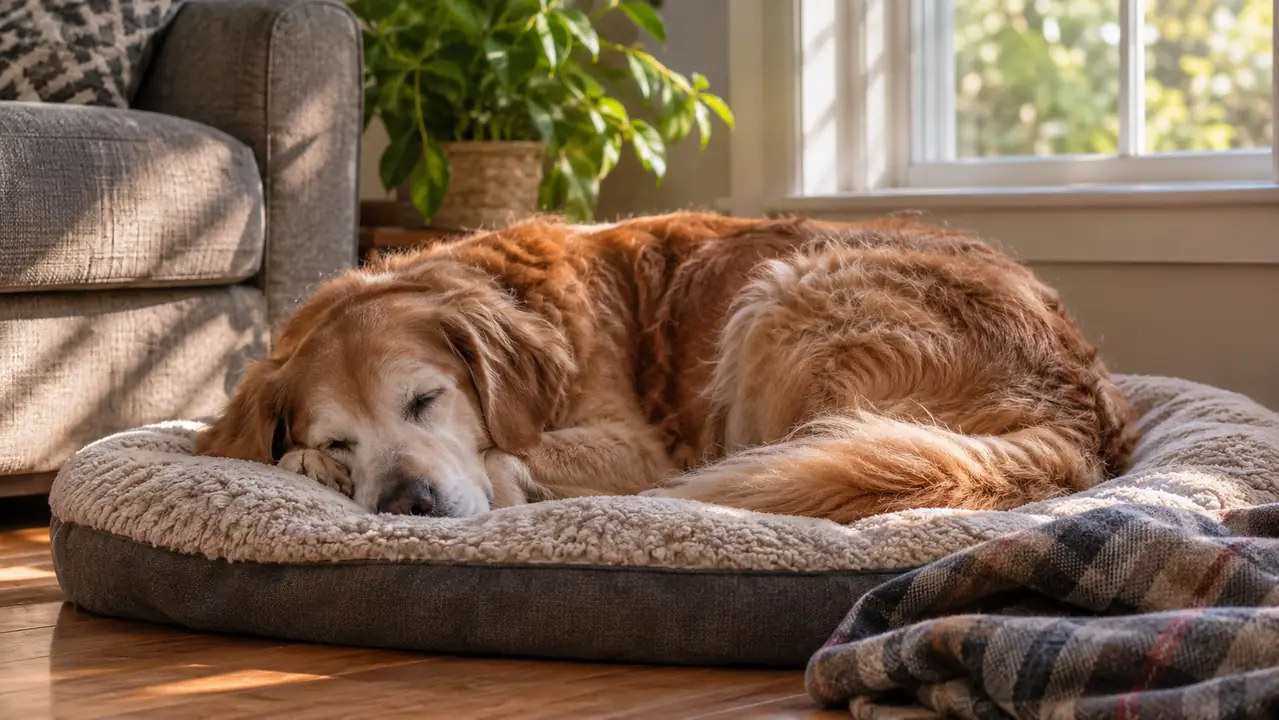
And standing up off the hardwood after a long nap, which is when he is stiffest. I do not use the sling every time. I use it when he has been down for more than an hour and I can see him thinking about it. Standing is the moment he needs help and the moment I can give it without hauling on his collar.
Where It Falls Short
You cannot leave it on. It is not a harness a dog wears around the house, and the LOOBANI is not built as one. It goes on, you do the transfer, it comes off and goes back on the hook. If you were hoping for something the dog wears all day so you can grab it whenever, this is not that product.
It takes two hands and some coordination. On a narrow staircase you and the dog both have to be going the same direction at the same speed, and for the first week that is not true. If your dog lunges or bolts, this is not a restraint and it will not stop him. It is one more thing to hold, and on a bad morning it is one more thing to hold badly.
The least graceful moment came on a Saturday in May, when Tom was at the store and Biscuit decided the mail truck was worth getting up for. I had the sling half set and he was already moving, so what I ended up with was a strap looped around my wrist and a dog three feet ahead of me in the hallway. Nobody was hurt and nothing was damaged. It was not dignified for either of us. A second person solves that, and on weekdays there are two of us.
And it does nothing about the reason his hips hurt. His weight, the exercise he can still do, the medication our vet prescribed, the carpet runner I finally put down on the hardwood, all of that does more than a sling. The sling is what you use between those things. I would not buy it instead of a vet visit, and if I am honest, I spent most of the first month using it as an excuse not to have that conversation.
What I Liked
- Takes real weight off the back end on stairs and during car loading
- Soft sheepskin-like lining, no rubbing on a 68-pound dog after four months
- Drawstring snugs it well enough to cover more than one dog's shape
- Nylon shell, machine washable, comes with a storage bag
- Light enough to keep by the door and use without thinking about it
Where It Falls Short
- It does not lift the dog. You do, and that is the entire mechanism.
- Not a walking harness and not a restraint
- Most dogs need a week or two of training before it is genuinely useful
- Awkward on a narrow staircase until you and the dog find a rhythm
Who This Is For
Biscuit is the case this thing was built for. A large dog, twelve years old, stiff in the back end, still strong on the flat and still wanting to be wherever Tom and I are. If your dog has started hesitating at the bottom of the stairs or at the back of the car, and you can still take a share of his weight without hurting yourself, the LOOBANI sling is a simple tool and it will earn its hook in the first week. It suits a carpeted staircase, hardwood floors and a deck with three steps, which is our house exactly.
It also suits a household with two people in it, honestly. One of you holds the dog and the sling, the other opens the door or spots the landing. That is how most of our transfers go, and it is why the thing lives by the door instead of in a closet.
Who Should Skip It
Skip it if your dog is much heavier than 68 pounds and you have back trouble of your own, because then you need a second person or a ramp, not a strap. Skip it if your dog will not tolerate anything touching his hindquarters, at least until your vet or a trainer has looked at why, because a strong reaction to being handled there can mean more than stiffness. And skip it if what you actually want is a harness for walks. This is not that, and no lift sling is.
One more. If you are looking for something that will make your dog strong again, this is the wrong purchase and no product is the right one. Strength comes back slowly, through the movement your vet clears him for, and a sling is only there to keep him safe while he does it.
It hangs by our back door and it has earned the hook
If your dog has started stopping at the stairs, this is the simplest thing I have found that changes the twenty seconds that matter. Machine washable, about fifteen ounces, nothing to assemble.
Amazon Check Today's Price on Amazon →Biscuit is asleep on the rug behind me while I write this, on the hardwood, and he got there by himself. In April he would not have. The sling is not why his hips are better, if they are better. It is why the staircase is not the end of his day. That is a smaller claim than the product page makes, and it is the true one.