
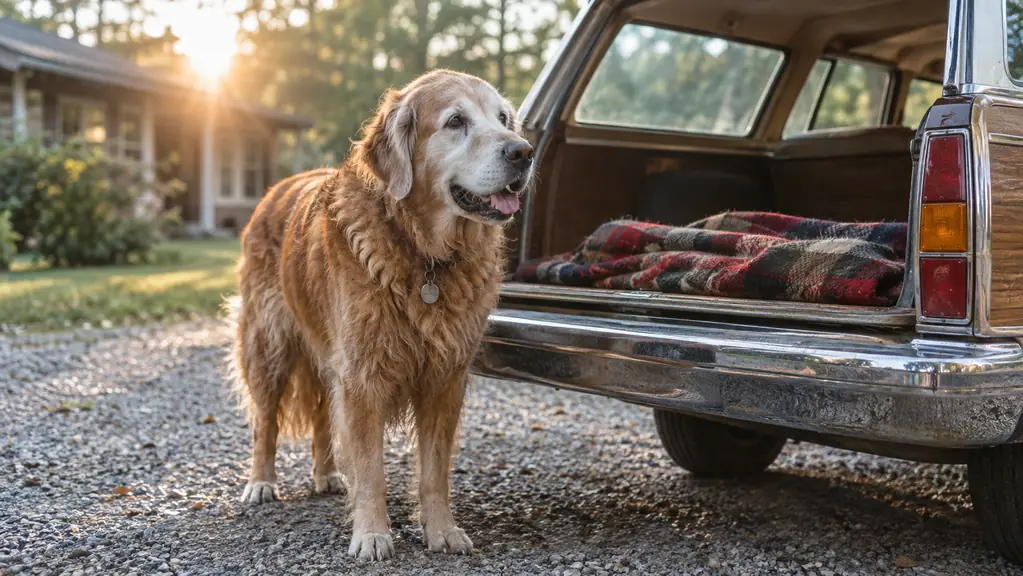
I bought the PetSafe Happy Ride Folding Dog Ramp in March, not because I wanted another piece of gear in the garage, but because Biscuit had started stopping at the back of the Outback like the bumper was a cliff. He is a 12-year-old Golden Retriever, about 68 pounds, and our vet diagnosed mild hip arthritis when he was 10. He still walks the neighborhood, still wants to ride to the park, and still looks at me like I have betrayed him when I lift his front paws. The PetSafe ramp was my attempt to stop lifting and let him keep some dignity. This is the honest version, including the parts I wish the listing photos had shown.
I have used it for four months on the tailgate of a Subaru Outback, on a paved driveway, on grass, and on a wooden deck. I have folded it, carried it, wiped it down, and left it leaning in the garage. I have not used it on a truck bed or a steep van, so I will not pretend to know how it behaves there. What follows is what I can stand behind after daily use with one dog.
The Quick Verdict
A genuinely useful 10-pound ramp for a large senior dog, if you have the floor space and your vehicle height is not extreme. The grip is good, the latch is fussy, and 62 inches is longer than the photos suggest.
Amazon Check Today's Price →The ramp that got Biscuit back into the Outback without a lift
It will not make an arthritic hip new. It removes one hard moment from the day, and for us that was the moment that mattered.
Amazon Check the PetSafe ramp on Amazon →How I Tested the PetSafe Happy Ride Ramp
Biscuit's vet is the one who suggested a ramp, not me. She said the jump down is harder on the joints than the jump up, and that a dog who hesitates at the tailgate is telling you something. I ordered the PetSafe ramp the same week. My husband Tom thought I was overreacting. Tom now uses it to load the recycling bins, so there is that.
I tested it the way I do everything, with a notebook and a pencil. For the first two weeks I wrote down whether Biscuit used the ramp without a treat, whether the base moved when his front paws hit it, and whether I had to reset the top edge against the bumper. After that I stopped writing and just used it. By the end of four months I knew which parts I trusted and which parts I did not.
I also paid attention to my own body. I am 64 and I have a right shoulder that complains. Lifting 68 pounds of reluctant Golden Retriever is not a neutral act. The ramp had to work for both of us, not just for him.
I did not test the 150-pound load capacity with weights. I tested it with a 68-pound dog and a 10-pound ramp, which is the real-world math. If you have a 140-pound Mastiff, your experience will be different.
What the Specs Mean in a Driveway
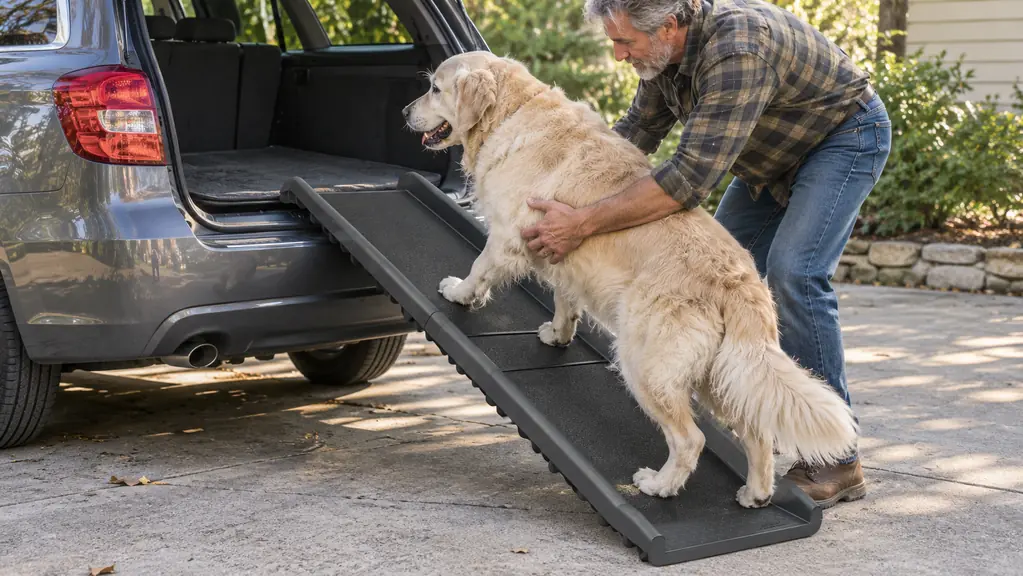
PetSafe lists the ramp at 10 pounds, 62 inches long, 16 inches wide, and 4 inches high. The load capacity is 150 pounds. The material is plastic. Those numbers tell you most of what you need to know before it arrives.
Ten pounds is light enough for me to carry from the garage to the driveway with one hand, but not graceful. The ramp is long, so the weight is spread out. I would not want to carry it up a flight of stairs every day. I keep it behind the passenger seat in the Outback and it stays there.
Sixty-two inches is the number that surprised me. In the photos the ramp looks tidy. In my driveway it covers a good stretch of concrete. That length is what gives it a gentle angle, and a gentle angle is the whole point for a stiff dog. It also means you need a clear landing spot and a vehicle that can spare the space.
Sixteen inches wide is enough for Biscuit. He is a Golden, not a giant breed. If your dog is broad across the chest or tends to drift sideways, the low side rails help, but they are not a channel. I would not call this a wide ramp. I would call it adequate for a large dog who is calm.
One hundred fifty pounds is more than double Biscuit's weight. I still would not let him gallop up it. The plastic has some give in the middle, and I can feel it when he pauses. It has not cracked, and PetSafe covers it with a one-year warranty, but this is a ramp for walking, not for leaping.
The First Week Is the Part Nobody Warns You About
The ramp arrived folded in a cardboard box. I opened it on the living room floor, which was a mistake, because the safety release latch snapped open and the ramp unfolded across the rug. Biscuit left the room. The first lesson is to open it in the garage or the driveway, not in a small space with a nervous dog watching.
For the first three days Biscuit would not touch it. He stood at the bottom and looked at the ramp, then at me, then at the car. I did not push. I put the ramp flat on the driveway and put a few treats on the surface. He ate the treats and backed away. On day four he put one front paw on it. On day six he walked all the way up for a piece of cheese. That is the honest timeline.
The first week is also when you learn your own habits. I had to remember to set the top edge against the bumper, press the rubber feet down, and keep the leash loose. If I rushed, Biscuit felt it. If I stood beside him and kept my hand near his harness, he went up. The ramp did not train him. I did, with the ramp.
Grip, Flex, and the Parts the Listing Photos Miss
The treads are the part I care about most. Biscuit's back feet are the ones that slip. The high-traction treads gave him something to push against on dry pavement and on the wooden deck. On wet grass, mud packed into the treads and I had to wipe them with an old towel. That is not a defect. It is what happens to any textured surface in a wet yard.
The four rubber feet did their job on the driveway and the deck. On the smooth concrete of the garage, one foot slid when I set the ramp down too fast. I learned to set it, press it with my foot, and then let Biscuit approach. If your dog rushes the ramp, the feet are not going to save you from a bad placement.
The side rails are low. They give a nervous dog a visual edge, and they gave Biscuit something to brush against when he first started. They will not stop a dog who panics and tries to jump off the side. I stayed beside him for the first two weeks with a hand near his harness.
The safety release latch is the part nobody mentions. It is there to keep the ramp from unfolding when it is folded, and it does that well. It is also stiff. I have to use two hands when I am in a hurry, and I have strong hands. If you have arthritis in your thumbs, ask someone else to open it the first few times.
The hinge is a bi-fold design, so the ramp folds in half. That is how it fits behind the seat. The folded package is 4 inches high according to the listing, and it is easy to slide into the cargo area. I would not call it compact. I would call it manageable.
The ramp does not make Biscuit younger. It removes the one moment in the day when I used to have to lift him, and that has been worth the floor space.
Where the Ramp Earns Its Space
The ramp earns its space on the days Biscuit wants to go somewhere. He is 12. He sleeps more than he used to. But when I pick up his leash, he still does a little shuffle toward the door. The ramp lets him get into the Outback without the pause at the bumper. That pause used to last five or six seconds, and then he would look at me. Now he walks up.
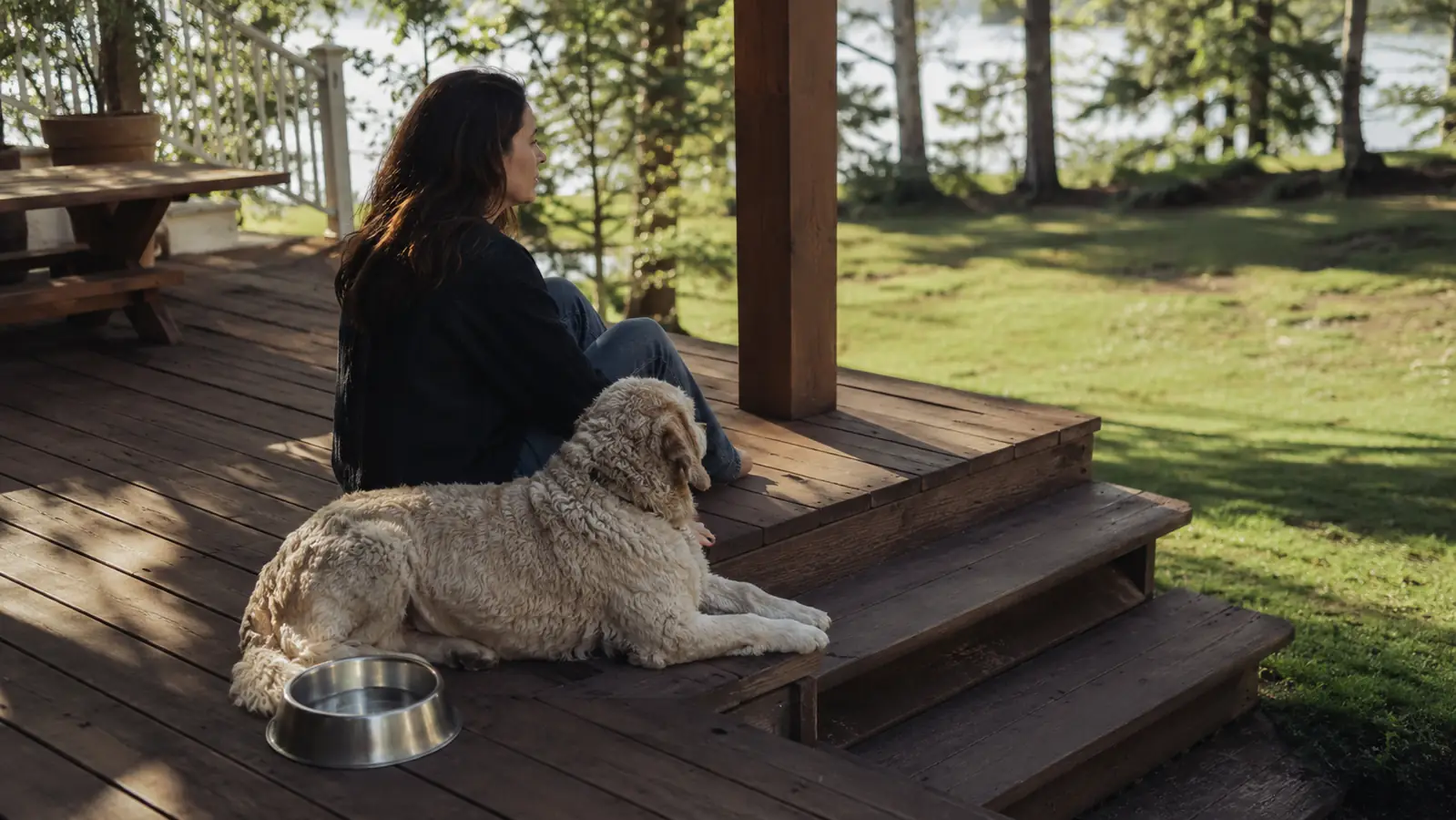
It also helped on the back deck. We have three steps down to the yard, and Biscuit had started to take them one at a time with a long pause on the landing. I set the ramp on the deck for a week, from the landing to the grass, and he used it without a treat by day three. That is not why I bought it, but it is why I kept it.
Where It Falls Short
The length is the tradeoff. A 62-inch ramp is not something you tuck into a corner. In the Outback it takes up most of the cargo floor when it is not folded. Folded, it still leans against the wall in my garage and I have to move it to get to the recycling bin. If you have a small car, measure first.
The latch is my least favorite part. I understand why it exists. I do not understand why it has to be that stiff. I have gotten used to it, but I still set the ramp down and use both hands to release it. If I am holding Biscuit's leash, I have to loop the leash over my wrist. That is a small thing that happens every single time.
The plastic flex is the other thing. I can see the ramp bow slightly when Biscuit is in the middle. PetSafe says the capacity is 150 pounds, and I believe the ramp can hold that. I do not believe it feels rigid. For a dog who is nervous about a moving surface, that slight give might matter.
Finally, the ramp is not a treatment. Biscuit still takes his joint supplement, still sees the vet, and still has slow mornings. The ramp removes a jump. It does not remove arthritis. I would be doing you a disservice if I let you think otherwise.
What the Reviews Get Right and What They Miss
The PetSafe ramp has 4.1 stars across more than 15,000 ratings. That is a lot of experience in one place. The reviews I read before buying mentioned the same things I noticed: the ramp is long, the latch is stiff, and the plastic flexes. They also mentioned that dogs either take to it or they do not. That matches what I saw.
What the reviews miss is the daily routine. A ramp is not a one-time purchase. It is a thing you set up and take down, or a thing you leave in the car and move when you need the cargo space. The people who love it are the people who made it part of the routine. The people who hate it are the people who expected it to work like a permanent fixture. I am in the first group, but I understand the second.
What I Liked
- 10 pounds, light enough for one person to carry
- 150-pound load capacity is more than enough for a large dog
- High-traction treads and side rails help a hesitant dog
- Four rubber feet held on pavement and deck
- Folds in half and fits behind a seat
- Made in the USA and covered by a one-year warranty
Where It Falls Short
- 62 inches long, so it needs real storage space
- Safety release latch is stiff and takes two hands
- Plastic has visible flex in the middle
- Treads collect mud and need wiping
- 16 inches wide is adequate, not generous
- Not a fix for severe mobility loss
Who This Is For
This is for the owner of a large senior dog who still wants to get into the car but has started to hesitate at the bumper. Biscuit is 68 pounds and 12. If your dog is in that range, and your vehicle is a sedan, SUV, or van with a tailgate that is not chest high, the PetSafe ramp is a practical tool. It is also for the person who is tired of lifting. I was tired of lifting.
It helps if your dog is food motivated and willing to learn. Biscuit is both. The first three days he would not put a paw on the ramp. I used a trail of small treats and the same word every time. By day six he walked up without a treat. A dog who is terrified of the ramp may never use it, and that is not a failure of the ramp.
Who Should Skip It
Skip it if your dog has severe hip or rear-leg weakness and cannot support his own weight on a sloping surface. A ramp can be dangerous for a dog who cannot place his feet. Ask your vet first. Skip it if you have a very tall truck bed or a steep drop, because 62 inches may not give you a gentle enough angle. Skip it if you want a permanent solution for a staircase. This is a portable ramp, not a stairlift.
Skip it if you have a giant breed over 150 pounds. The capacity is 150, and I would not push that number. Skip it if you have no place to store a 62-inch object. Skip it if your dog panics on narrow surfaces. And skip it if you are looking for a cure. This is a help, not a cure.
If your dog still wants to go, this is the least dramatic way to help
PetSafe made a 10-pound ramp that fits a large dog and a normal SUV. It has a stiff latch and a long footprint, and I would buy it again.
Amazon See the PetSafe ramp on Amazon →